How to Turn 1 Sales Call Into a Weekly Newsletter With Claude Code
Every sales call you run is a newsletter issue waiting to be written. This workflow extracts buyer questions, objections, and "aha" moments from your call transcripts and turns them into a focused, voice-matched newsletter, automatically, every week.

Will Leatherman
Founder, Catalyst
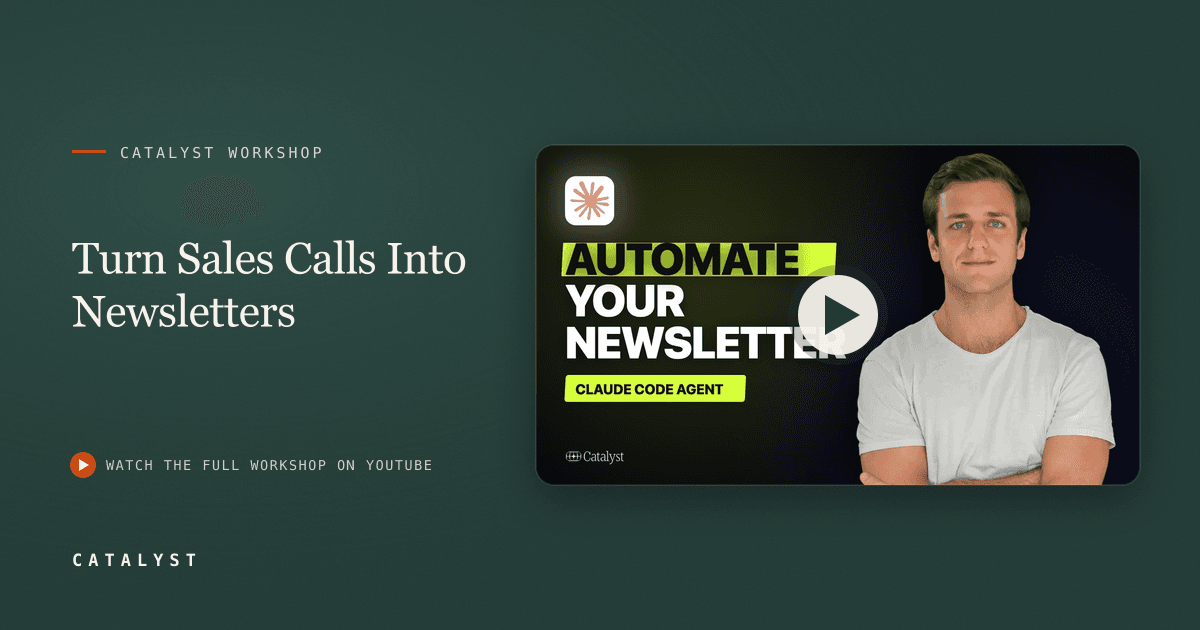
TLDR
Most newsletters stall because the writer starts from a blank page. This Claude Code workflow flips that. You feed it a sales call transcript. It mines the call for buyer language, picks the sharpest single idea, writes a newsletter issue in your voice, and queues it for review before send. The only creative decision left is whether to approve it.
Sales calls are already full of newsletter content. Every discovery call has buyer questions, objections, pain points described in the prospect's own words, and the moments when something clicked for them. Most founders and marketers let all of that disappear into a CRM note. This workshop shows you how to route it into a repeatable newsletter instead.
Why does the blank page problem keep coming back?
The blank page problem is a sourcing problem, not a writing problem. When you sit down to write a newsletter with no material queued, you are asking yourself to invent a topic that is relevant, specific, and resonant — cold, on deadline. You will not reliably do that.
The fix is to separate sourcing from writing. Sales calls give you the sourcing. Every qualified discovery call contains at least one question the prospect asked that dozens of other buyers are thinking about right now. That question is your topic. The answer you already gave on the call is your draft.
As Will put it in the workshop: "If you're constantly understanding what is working — this information is so helpful for your next marketing campaign, how you construct your landing page, passing this back to your sales team." The newsletter is one output of a richer habit: mining your calls.
What does the 3-step workflow actually do?
The workflow has three Claude Code prompts, each saving its output before passing to the next. Running them as separate steps matters — you store the extracted call data once and every future workflow can pull from it without re-running AI on the raw transcript.
| Step | Prompt job | Output saved |
|---|---|---|
| Mine | Read the transcript. Extract real questions asked, objections raised, specific numbers or stories, how the buyer described their problem in their own words. | `mined-call.md` in your project folder |
| Pick | Score each extracted moment against your audience. Rank them. Pick the one that a reader who was never on the call would still find valuable today. State the issue idea as a subject line using the customer's own words where possible. | `issue-brief.md` |
| Write | Pull the mined data and the brief. Pull past newsletter issues for voice-matching. Write one newsletter issue: subject line, opening grounded in the real conversation, one idea, one CTA. | Draft in your editor or Beehiiv |
The key constraint at the "Pick" step: do not summarize the call. Find what other buyers are probably feeling. A question one qualified prospect asked is a question your whole ICP is asking. That framing is what separates useful newsletters from recap emails.
How do you set up the inputs?
You need three inputs before you run the workflow.
1. A call transcript. Any recorder works: Fathom, Granola, Atio, Gong, or a plain text export from your CRM. Will uses CircleBack and exports the transcript to a local folder that Claude Code can read. If you are not recording sales calls yet, start now. The transcript is a raw material that feeds not just newsletters but content strategy, landing page copy, and sales training.
2. A voice file. A short document describing how you write: sentence length, tone, the phrases you use, the ones you avoid. If you do not have one, pull 3 of your best past newsletters and paste them in. The model uses them for style matching.
3. A newsletter format template. One past issue you like, or a format you have defined. If you have neither, find a newsletter in your space that you respect and ask the model to analyze its structure as a starting point.
What does the output look like?
In the live session, Will ran the workflow against a real discovery call. The model identified this exchange as the strongest newsletter topic:
"Some of my research leads me to believe that those kind of pay-for-play sites can actually damage your AEO visibility."
The model picked it because the concern — whether paid placements hurt AI search rankings — is something every marketer in Will's audience is weighing right now. The resulting newsletter subject line was a question (Will's best-performing format), the opening grounded the reader in the real conversation ("I was on a call this week with a marketer running an SEO solar company..."), and the body answered the question directly.
That is the structure that works: subject as question, opening as a specific real moment, body as the answer, one CTA. Every element comes from the call. Nothing is invented.
How do you make it run automatically every week?
Once the three prompts are working and producing good output, you schedule the workflow. Will's setup: the agent runs at 6am on newsletter day, processes the most recent call transcript, saves the draft, and his team does a human pass before 9am send time.
The feedback loop that makes it better over time works like this. Once you have published issues, feed past performers back in as an input to the "Pick" step. The model learns which topics drove better open rates and click-through rates, and starts weighting its ranking toward topics with those characteristics. The system compounds.
For deeper reference on building AEO-optimized content that gets cited by AI engines, see the Catalyst AEO article framework and the AEO Scanner audit tool to benchmark where you stand today.
The takeaway
Your sales calls are a weekly content brief you are currently ignoring. The Claude Code workflow in this session mines each call for the sharpest buyer question, picks the one idea most relevant to your ICP, and writes a newsletter issue in your voice — in three prompts. The next action: pull your last discovery call transcript, run the "Mine" step, and see what it surfaces. You already have the material.
The Content Engineer
Enjoyed this article?
Frameworks like this, weekly. No fluff, just original research and actionable insight.
More in Content Strategy
How to Build a Claude Code Engine That Turns Any Transcript Into a Week of Platform-Native Content
Most B2B teams leave their best content buried in recordings. This workshop walks through a live Claude Code build that mines any transcript for ideas, writes platform-native drafts in your voice, and schedules itself to run every week without manual input.
How B2B Marketing Teams Get Named in ChatGPT Perplexity and Google AI
86% of buyer queries go unanswered by most B2B companies in AI search. Here is the 3-component system to change that, grounded in a live audit of a real healthcare IT company.
How to Build a Claude Workflow That Turns 1 Daily Idea Into 5 Ready-to-Post Drafts
Most B2B founders have content ideas they never ship. This 3-document setup and a single Claude co-work task changes that, producing platform-ready LinkedIn, Instagram, email, TikTok, and newsletter drafts from one captured idea every day.
Ready to turn insight into pipeline?
We work with B2B companies that know content is the moat. Let's talk.