How B2B Marketing Teams Get Named in ChatGPT Perplexity and Google AI
86% of buyer queries go unanswered by most B2B companies in AI search. Here is the 3-component system to change that, grounded in a live audit of a real healthcare IT company.

Will Leatherman
Founder, Catalyst
TLDR
Getting cited in [ChatGPT](https://chatgpt.com), [Perplexity](https://www.perplexity.ai), and Google AI requires 3 things working together: on-site content that says something only your company can say, off-site mentions in category "best of" publications, and a technical setup that lets LLMs crawl and parse your site. Frontloading the answer in the first third of each page is the single fastest fix — 44% of ChatGPT citations come from that zone.
Most B2B pages open with a brand paragraph and bury the answer in the middle. AI engines are lazy — they pull from the first third of the page and skip the rest. If your best answer is on paragraph seven, you are invisible in AI search even if you have the right content on the page.
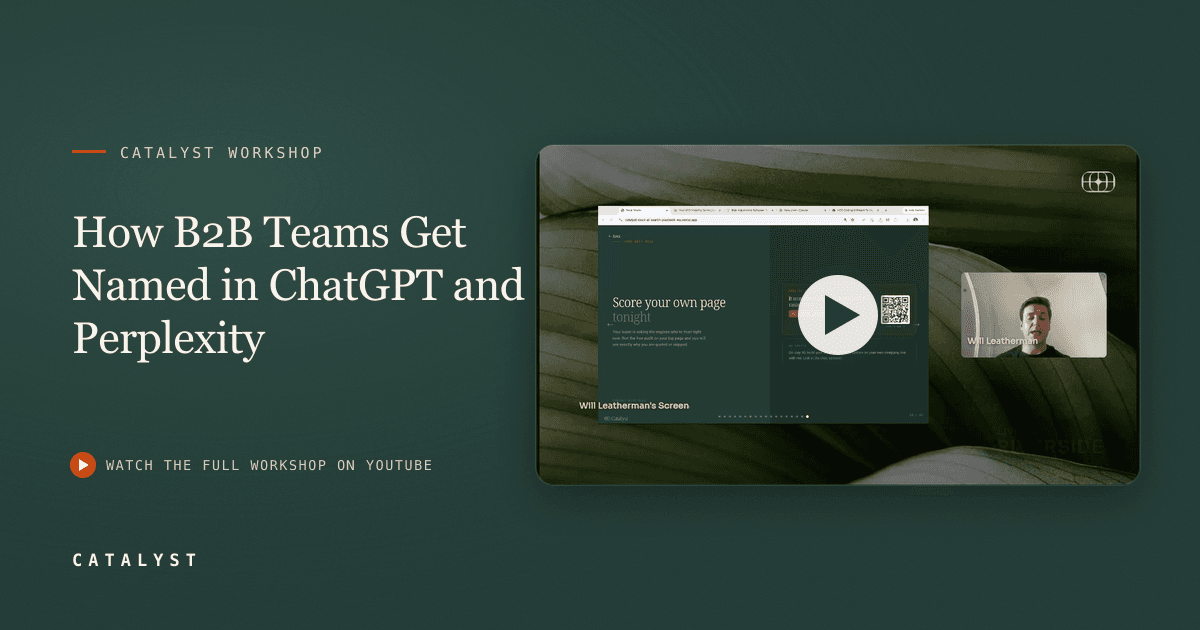
This workshop walked through a live audit of a healthcare IT company (InferScience) to show exactly where visibility breaks down and what to fix first. The same framework applies to any B2B category.
Why are LLMs skipping most B2B websites?
An LLM builds its answers by quoting the most specific, original source it can find. If the same claim appears on 10,000 pages, the engine already has that in memory and will answer without citing anyone. The only content that forces a citation is content the engine has not seen before — something it has to go find because it does not already know it.
The test: before you publish anything, ask "could someone else have written this?" If yes, the LLM will likely skip it. If no — if it could only have come from your specific company data, customer research, or methodology — that is what gets quoted.
Pages that publish original cited research see 40% more citations across AI engines, according to Catalyst's testing across 150 B2B clients. That is the biggest single on-page lever available, and almost no one pulls it because it feels like extra work.
What are the 3 components of AI search visibility?
AI visibility is not one problem. It is three distinct problems that compound:
| Component | What it means | Why it matters |
|---|---|---|
| On-site content | Original, front-loaded, source-backed content on your own domain | LLMs pull directly from owned pages when the answer is strong enough |
| Off-site mentions | Being featured in third-party "best of" lists and category publications | Most categories have 5-15 high-authority publications writing comparison lists that get cited more than brand sites |
| Technical | Crawlable site, no aggressive JS blocking, LLM.txt file in place | If the engine cannot read your site, none of the content work matters |
Most B2B companies focus only on on-site content while ignoring off-site mentions. In practice, third-party "best of" publications often get cited more than company-owned pages, especially in categories with established review ecosystems like healthcare IT or CRM.
For a deeper look at competing against high-authority off-site sources, see How to Win AI Search Citations Against Higher-Authority Competitors.
Where on your page should the answer appear?
44% of ChatGPT citations come from the first third of the page. This is the most actionable data point from Catalyst's citation research. LLMs do not read your entire page — they scan the top and pull.
The fix is structural:
- Move your single most specific claim into the first paragraph
- Answer the buyer's core question in 1 sentence before you describe how you do it
- Cut hero paragraphs that lead with your brand story — replace them with the outcome you deliver
The InferScience audit scored their hero section as "structurally okay" — outcome stated in the CTA — but flagged that generic benefit claims opened the page rather than specific case data. Moving even one customer result or statistic above the fold would measurably improve citation rates.
How do queries actually look in AI search and why does that change your keyword strategy?
74% of AI search queries start with "best of" framing — something like "what is the best risk adjustment healthcare IT software for mid-stage health plans." That is a 15-word query. The equivalent Google search was 3 words.
This has two implications:
- There are far more specific keyword combinations to rank for. A company that was invisible on "best CRM" might rank clearly for "best CRM for 200-person RevOps teams running outbound sequences."
- "Best of" framing is the dominant pattern, which means your content needs to answer that framing directly — not just describe what you do, but position your company as the answer to a specific buyer situation.
Adding the year (e.g., "2026") to queries also signals recency, which LLMs weight. If your content does not acknowledge the current state of the category, it looks stale to the engine.
What does a real B2B AI audit look like?
The live audit of InferScience — a healthcare IT company specializing in risk adjustment — surfaced findings common across most mid-market B2B companies:
Visibility snapshot:
- Ranked #12 out of 27 companies in its category
- 86% of buyer queries answered without the company appearing
- Showing up on Claude and Gemini, but not on ChatGPT (the largest engine) or Google AI
- G2 profile found and credited — positive signal for LLMs because real customer sentiment is visible
- No Wikipedia presence, no tier-1 press coverage, no LLM.txt file
What was holding it back:
- Off-site: not featured in any of the 10 high-authority category publications writing "best of" lists for HCC coding and risk adjustment software
- On-site: statistics on the page lacked source attribution — the engine could not verify the claims and did not cite them
- Technical: no LLM.txt file, which is the first thing an LLM looks for when it lands on a site
Quick wins identified:
- Contact the authors of those 10 publications and ask to be added to the lists
- Add source attribution to all statistics (link to the underlying customer data or external study)
- Deploy LLM.txt to surface the site's structure immediately
The gap from position 12 to 6 or 7 was achievable with those three changes alone, without producing new content.
Run a free audit of your own company at gotcatalyst.com/aeo.
How can you score any page for AI citation readiness?
Will shared 3 prompts you can run in any LLM today:
Prompt 1 — Score the page (0-10 on source density, front-load, and originality):
Score this page 0–10 on source density, front-load, and originality. Could a competitor have published these sentences? List the highest-impact fixes first. [paste the page text]
Prompt 2 — Find the line only you could write:
Scan this page and identify the sentences that could only have come from this specific company — based on unique data, customer outcomes, or methodology. List them. [paste the page text]
Prompt 3 — Run the visibility check:
I am researching vendors for [your category]. What companies do you consistently recommend and why? Which sources are you citing?
The first prompt is the fastest diagnostic. Run it on the page you believe should be ranking for a query where you are not showing up. The score will tell you whether the problem is structure, originality, or missing source attribution.
For a full breakdown of how to create content that outranks higher-authority competitors on AEO, see How to Beat Higher-Authority Rivals to the AI Citation.
How often should you be checking your AI search rankings?
Unlike SEO, AI search gives a fast feedback loop. Will reported that companies making on-site changes see the citation impact within days or weeks, not months.
LLM answers are also inconsistent by design — run the same query in ChatGPT twice and you may get different companies. This means a single snapshot is not meaningful. The goal is to show up in 3 to 5 of every 10 answers consistently, not to hold a fixed "position 1."
Checking every 2 weeks gives enough data to see whether changes are moving the signal. Catalyst's AEO scanner runs 100 different queries across all 5 major LLMs and aggregates the results, which removes the noise from individual answer variation.
The takeaway
The 3-component framework is straightforward: original on-site content with answers frontloaded in the first third, featured in high-authority off-site "best of" publications, and a site that LLMs can crawl cleanly. Most B2B companies are missing all 3.
The fastest single fix for most companies is moving the specific answer up. Take one page that should be ranking but is not, run Prompt 1 above, and implement the top 2 fixes. Then check the audit tool 2 weeks later.
If you want to see where your company currently stands, run the free AI visibility scan at gotcatalyst.com/aeo — it runs 100 queries across ChatGPT, Claude, Perplexity, Gemini, and Google AI and shows exactly which queries you are and are not appearing in, which competitors are ahead of you, and which off-site publications to target first.
The Content Engineer
Enjoyed this article?
Frameworks like this, weekly. No fluff, just original research and actionable insight.
More in Content Strategy
How to Turn 1 Sales Call Into a Weekly Newsletter With Claude Code
Every sales call you run is a newsletter issue waiting to be written. This workflow extracts buyer questions, objections, and "aha" moments from your call transcripts and turns them into a focused, voice-matched newsletter, automatically, every week.
How to Build a Claude Code Engine That Turns Any Transcript Into a Week of Platform-Native Content
Most B2B teams leave their best content buried in recordings. This workshop walks through a live Claude Code build that mines any transcript for ideas, writes platform-native drafts in your voice, and schedules itself to run every week without manual input.
How to Build a Claude Workflow That Turns 1 Daily Idea Into 5 Ready-to-Post Drafts
Most B2B founders have content ideas they never ship. This 3-document setup and a single Claude co-work task changes that, producing platform-ready LinkedIn, Instagram, email, TikTok, and newsletter drafts from one captured idea every day.
Ready to turn insight into pipeline?
We work with B2B companies that know content is the moat. Let's talk.