How to Turn Your Founder's Calls Into a Week of Posts With 2 Claude Cowork Agents
Build a research agent and a writer agent with no code, so what your buyers complained about this week gets answered in your founder's own words, sourced to the exact minute they said it.

Will Leatherman
Founder, Catalyst
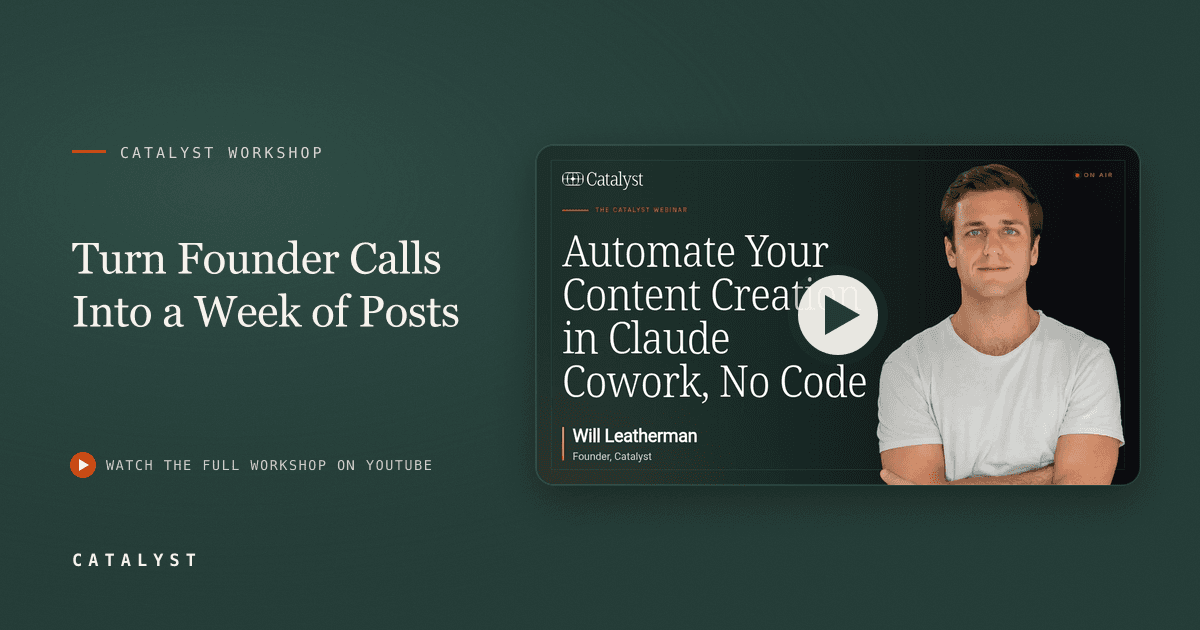
TLDR
Every post worth publishing starts from something your founder has already said on camera or on a sales call. Two agents in Claude Cowork turn that into a weekly habit. A research agent reads what buyers complained about across the last 14 days and keeps only the pain points answered somewhere in those recordings. A writer agent drafts those into LinkedIn posts, an X thread and a newsletter section in that founder's voice, attaching a review sheet that shows the call and the minute behind every claim. Both run on a schedule each Monday, and neither one publishes anything without a human saying yes.
Open Claude, type "write me 5 LinkedIn posts about B2B marketing", and what comes back is clean, on topic and recognizable to nobody. The draft had nothing of yours to work from, so it filled the gap with a generic statistic and an opinion every marketer has read many times already.
Publishing that costs more than it used to. LinkedIn now lets anyone flag a post as AI slop, and CNN covered the crackdown in October 2026. Content the platform classifies that way gets roughly 40% fewer views, and the penalty carries into future posts. Meanwhile the sales meetings go to the competitor publishing what they actually think every week.
What you need is already recorded. It sits in your podcasts, your demos, your customer calls and your AMAs, and almost none of it ever reaches a feed. A content library is one file holding every idea, number, story and quotable line your founder has said out loud on a recorded call. Each entry carries a theme, the call it came from and the minute it was said.
Catalyst has built this with more than 150 companies, and one rule comes first every time.
"If there's no answer on a call, we can't make the post." — Will Leatherman, Founder of Catalyst
The web tells you what to write about. The answer always comes from a call, at a timestamp you can go back and check. What follows is the full build from a live workshop. A stand in founder named Marin runs an AI native CRM company throughout, so you can see every file before pointing the agents at real calls.
Why does AI content sound like nobody wrote it?
Four problems come up again and again, and the research backs all of them. The Content Marketing Institute's B2B research puts numbers on three of the four.
| Problem | What it looks like | The data |
|---|---|---|
| Your best thinking dies on the call | A founder says something brilliant on a podcast and it is simply gone | 4 in 10 marketers name access to subject matter experts as a top problem |
| It sounds like no one | The draft reads fine and could have come from any company | About half say brand voice is a top issue with AI content |
| It makes things up and you get blamed | Claims appear that nobody approved | More than half name accuracy as a top issue |
| Sign off turns into a rewrite | The draft bounces 4 or 5 times before it goes out | Editing takes longer than writing from scratch |
Each one is worse than it looks. One marketing leader described a whole podcast dying after a single post. A coach recorded over 100 client calls in a year and worked out that 2 posts from each was 200 posts never written. You cannot book the founder for an hour to recover what they already said for free.
The accuracy problem is the one that burns people.
"If you don't give it what's true, it will make it up and fill in the gaps mostly incorrectly." — Will Leatherman, Founder of Catalyst
Do better prompts or a brand voice agent fix this?
Three quick fixes get tried first, and each one solves part of a problem while leaving the main one standing.
- A sharper prompt helps a little. The best prompt ever written still has none of your founder's numbers or stories to draw on, so it invents plausible ones.
- A custom agent trained on your brand voice helps with how the writing sounds. The underlying ideas stay borrowed from whatever the model already knew.
- Letting the founder edit moves the hours back onto their calendar. Founders rewrite everything because they cannot tell which lines are theirs and which the model invented.
"Voice without your ideas is still going to end up as slop. It's just slop that sounds a bit more like you." — Will Leatherman, Founder of Catalyst
What do you need before you start?
Four things, none of which require writing code.
- Claude Cowork, with a web search connector switched on. Parallel is free to turn on and built for agents rather than people.
- One folder holding a short note on who you sell to, where those buyers talk, and the channels you publish on.
- Another folder holding transcripts of calls that already happened. Messy auto captions are fine, and one transcript alone can carry a week of content.
- Three posts written by the person whose voice you want, ones they are happy with.
Nothing gets copied by hand. If your calls sit in a recorder that connects to Claude, or your notes live in Notion or Google Drive, Claude reads those directly once you switch the connector on in settings.
The workshop build ran in Claude Code so the files and the chat were visible side by side on screen. Every step behaves identically in Cowork.
Step 1. How do you build the library?
Start with the rules file. A CLAUDE.md file sits at the root of your folder and gets read at the start of every session, so anything written there holds across all future work. Put the core rule in it first. Every claim, number, quote and story in a draft has to trace to the ideas file, which traces to a real call. The research agent chooses the topic and never supplies the answer.
Then run the first prompt. It reads every transcript in the folder and files each belief, story, number and quotable line under a theme, stamped with its source call and timestamp. Repetition drives the ordering. When an idea surfaces on a second call it moves to the top, which tells you what the founder genuinely believes rather than what they said once.
On the sample run, the top entry traced back to minute 56:58 of a podcast. Nine lines down, the customer who had been named at the top of that transcript appeared as their job title instead.
That swap is a rule in the CLAUDE.md file, replacing every customer, prospect and competitor with their role. It is what makes sales and customer calls safe to feed in. Calls under an NDA stay out entirely.
Step 2. What should you actually post about this week?
Most content calendars are a guess somebody made a month ago in a planning meeting. The post goes out and nobody in the market recognizes their own problem in it.
The research agent replaces the guess. It reads the market file you wrote in step 1 and searches where those buyers actually talk over the last 2 weeks. Pain points come back in the buyer's own vernacular, each carrying a link to where it was said. It notes which post formats keep showing up. Then it holds every pain point against the library and drops the ones nobody on your team has answered.
Each surviving topic pairs something a buyer said with something the founder said, and both halves are real and checkable.
Two rules never get skipped in this prompt. It never invents a link, a quote or an account. Quotes have to come from actual buyers rather than vendors selling to them, which keeps the agency noise out of your results. It also lists every source it read, so its work stays auditable.
The output includes a section worth more than the topics themselves. Questions buyers keep asking that the founder has never answered on any call are content nobody in your category has written yet. They are also the agenda for the next podcast episode.
A search tool built for agents matters here. Parallel can pull the full transcript of a podcast where your buyers are talking, which is where the useful pain points tend to be buried.
Step 3. How do you write a voice file your founder recognizes?
Most voice files are a list of adjectives. Confident, direct, a little witty. Every brand on earth claims those three, and a draft built from them gets rewritten.
Put real posts in instead. Models work better from an example they can read against than from a list of instructions. Drop in 3 posts the founder wrote themselves and considers good, then run a prompt that studies them. It measures how long the sentences run, how posts open, how they close, and which words never appear. Every rule it writes has to quote the line that produced it.
"A brand guide describes how you want to sound and the posts show how you actually sound." — Will Leatherman, Founder of Catalyst
Keep your existing brand guide and paste it underneath. The posts lead. Every post your founder publishes and likes goes back into this file, so it sharpens month over month.
Step 4. Will the writer agent produce posts your founder signs?
This is where most AI content dies. The draft lands with the founder, they do not recognize half of it, and they rewrite the whole thing.
The writer agent takes the top 3 topics from the research output and drafts a LinkedIn post for each, shaped like the founder's own posts. It writes an X thread on the strongest topic, plus one section for the newsletter. Each post opens on the buyer's pain the way that founder opens a post, then answers it from the library.
Channel rules live in the skill, so the drafts arrive already fitted to where they are going.
| Channel | Constraint written into the skill |
|---|---|
| About 140 characters show on a phone before "see more", so the hook lands inside that | |
| X | Posts cap at 280 characters |
| Newsletter | One section, drafted to sit inside an existing send |
Each channel gets its own folder so whoever schedules knows where to look. The sample run produced 5 LinkedIn posts, 1 newsletter section and 1 X post.
Then a second agent reviews the first one's work and writes a review sheet. Every claim, every number and every quote in every draft appears next to its source and the exact words the founder used. Teams in regulated spaces can add their own medical, legal and regulatory checklist to that review step and the agent runs it.
The format list is not fixed. A founder's answer to a buyer question can be a LinkedIn post, a newsletter section, a blog, the email sales sends after a demo, show notes, a script for a 60 second video, or a page answering the exact question buyers type into ChatGPT. Add the format to the market file in one line and the writer drafts it the same way, sourced line by line. That last format is how the same library feeds your AI search visibility work.
Step 5. How do you get both agents running without you?
Turn the work into 2 skills. A skill is a plain English document telling Claude which steps to follow, in what order, and what good looks like, the same way an SOP would for a new hire. Its name is what you type to run it, and its description tells Claude when to use it.
One skill reads new calls into the library and runs the research. The other drafts the week from whatever the research found. Both carry a "never" section saying they never publish or schedule anything without approval. Write those safeguards in at the start, so a person always decides what goes out.
Then ask Claude to put them on a schedule, research first and writer second, every Monday morning. Run each one by hand once and read the output before you automate it.
"A weekly run that stops to ask permission just becomes something that's waiting for a click." — Will Leatherman, Founder of Catalyst
Plenty of teams build the skills and never schedule them, then conclude the system does not work while a backlog quietly grows. Here is the rhythm that holds.
| When | Who | What happens |
|---|---|---|
| Monday morning | Both agents | Research runs, then the writer drafts the week |
| Monday afternoon | You | Pick the posts worth publishing and send the review sheet |
| Tuesday | Founder | Signs off in a few minutes against the sourced sheet |
| Ongoing | Everyone | Every recorded call grows the library |
You still choose the first post. You get 5 drafts and perhaps 3 are worth running. Keep that call yours until the output is dialed in. When the same mistake shows up twice, fix the voice file rather than the draft, and it stays fixed on every run after.
The feedback loop is the part teams underuse. It works the same way the 4 agent marketing team build does, where last week's results sharpen this week's drafts.
Can you safely feed in real sales calls?
Yes, with 3 controls in place, and they are worth setting up before the first transcript goes in.
Folder scope does most of the work. An agent only sees what is inside the folder you point it at, so giving each job its own folder set keeps it away from files it has no business reading.
Connectors carry their own permissions. Open manage connectors in settings and set each one to always allow, always ask or needs approval, which puts friction exactly where you want it.
Rules in CLAUDE.md handle the rest. Write a line restricting a connector to a specific scope, so a mail connector only reads messages from a named list of addresses, and the agent follows it every session.
On what public tools can see, a search connector reads LinkedIn posts because those render publicly without a login. Your own account analytics stay private and need a login, so no agent is pulling those.
The takeaway
Somewhere in the calls you have already recorded is a post better than anything you would write from a blank page. In the sample run it was a line from minute 1 of an October podcast, where Marin called her category's software "a graveyard of good intentions". Nobody had written it down.
Build the library from 3 existing calls this week. Everything downstream runs off it, including the pages ChatGPT quotes when your buyers ask who to work with, which get written from the same source material as the posts. Teams that start anywhere else end up automating the generic draft they were already unhappy with.
Then find out what AI currently tells your buyers about you. The free AEO audit shows how often you get recommended and which competitors get named in your place. It also surfaces the buyer pain points sitting behind those answers, which is your list of pages worth writing next.
The Content Engineer
Enjoyed this article?
Frameworks like this, weekly. No fluff, just original research and actionable insight.
More in AI Tools
How to Build a 4 Agent Marketing Team in Claude Cowork That Turns Last Week's Numbers Into This Week's Content
Four plain text files in one folder read your numbers on Monday, work out what moved them, and hand you next week's content by Tuesday, and every one of them is built so you can check its work in a few minutes.
How to Build an AI Marketing Team in Claude That Runs Without You Every Week
Most marketing agents get abandoned by week 3 because one agent was handed 5 jobs. Here is the 4 rule build, from an empty folder to a scheduled Monday report that posts itself to Slack, in about 20 minutes.
How to Build a LinkedIn Lead Gen Agent That Qualifies ICP Prospects From Viral Posts
When a LinkedIn post goes viral in your niche, its comment section is a pre-qualified list of buyers already signaling intent. This workshop shows you how to scrape those commenters, filter them against your ICP, and get a ranked outreach list — using either Relay App or Claude.
See where AI ranks you
The free AEO audit runs your buyers' questions through ChatGPT, Claude, Perplexity and Google AI Overviews, and shows where you are named and who is named instead.