How Ramp Wins 40% of AI Search Share of Voice With a 29 out of 100 Visibility Score
Ramp gets named first when a finance lead asks an AI engine for the best spend management software, and it scores in the bottom third on an AI visibility audit. The gap between those two facts is the whole lesson, and 5 of the 6 fixes it points to cost you an afternoon.

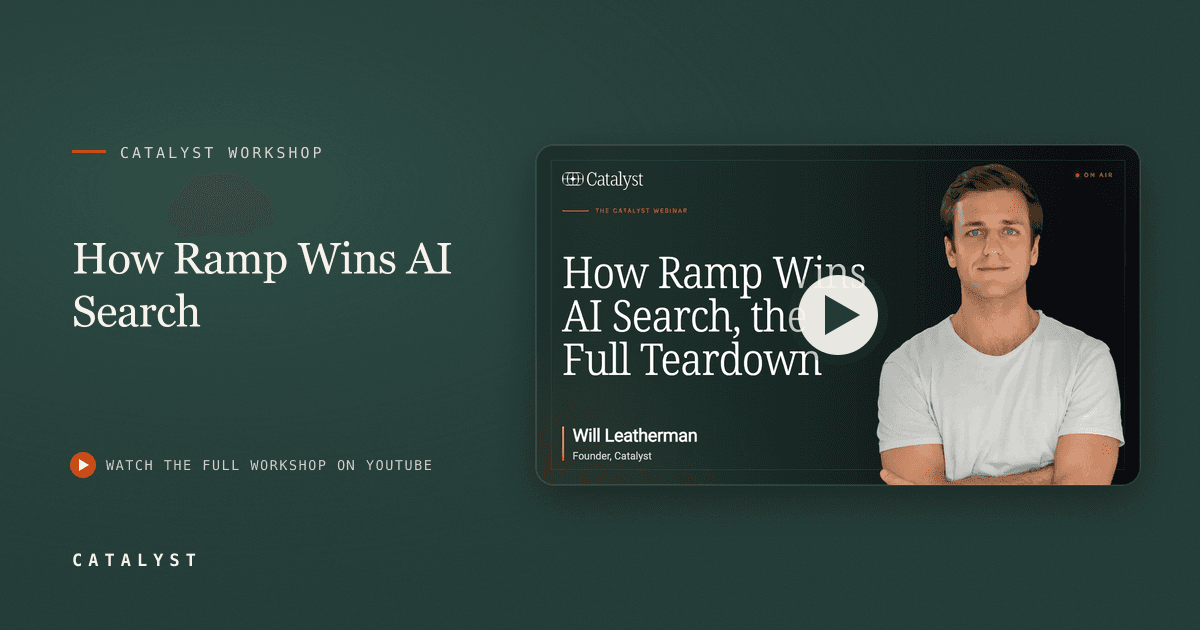
Will Leatherman
Founder, Catalyst
TLDR
Ramp holds roughly 40% of share of voice across the 6 vendors tracked in its category, and it scores 29 out of 100 on an AI visibility audit. Both are accurate. The audit grades what a crawler can read on the website, and Ramp's strongest work sits somewhere else, in a plain markdown version of its homepage served to any request that does not run a browser, and in a data feed piped straight into Claude and ChatGPT. Of the 6 fixes this teardown produces, 5 have nothing to do with company size. Start by fetching your own homepage with JavaScript disabled and reading what comes back.
Ask Google AI search for the best spend management software for a midsize company and Ramp is named in the first sentence of the answer. Run that same domain through an AI visibility tool and it scores 29 out of 100, which puts it near the bottom of its own category.
An AI visibility audit is a score of what a crawler can read on a website, and it exists so a marketing team can find out why an engine names a competitor instead of them. It grades 6 things. Whether off-site mentions name your category, whether your content survives a request that does not run in a browser, whether your markup labels what the page contains, whether a named author with a checkable track record signs the work, whether your pages carry real data, and whether the high intent questions of price and comparison get answered in text.
Ramp fails several of those and still wins. Working out why is worth more than the score.
Why does Ramp score in the bottom third and still own 40% of its category?
Because the audit grades the pages, and the work carrying Ramp lives outside them.
In May, Ramp stopped waiting to be cited and started shipping its data directly into the engines that would have cited it. Claude gets it through an Anthropic MCP server. ChatGPT gets it through OpenAI. Bloomberg Terminal has it built in, and Perplexity and Grok are rolling out. An engine with that connection turned on never has to find a Ramp page at all. It does not need to rank, win a comparison, or get cited. It asks Ramp for the number and Ramp answers.
"Ramp skipped citation and went straight to being the source." — Will Leatherman, Founder of Catalyst
No crawler sees any of that, so no audit scores it. This is the same pattern behind a site that fails every SEO check and still wins in ChatGPT. A low score tells you what your pages are missing. It cannot tell you what a competitor is doing off the page.
What does an AI engine actually get when it fetches your homepage?
Almost never what you see in a browser, and Ramp built a second homepage for exactly that reason.
Request ramp.com the way a tool requests it, with no browser and no JavaScript, and the marketing site does not come back. A markdown document does. Line one names the category. Every product carries a sentence about what you would use it for. All 3 pricing tiers appear further down as real numbers in text. A plain request to many of the 30 versus pages returns much the same document.
There is no navigation in it, no cookie banner, no related articles, no footer and no calls to action. Nothing a tool has to sort out of the way before it finds a sentence worth reciting.
"Same company, same day, two completely different answers depending on how you ask." — Will Leatherman, Founder of Catalyst
The browser version is weaker on all 3 counts. The H1 reads "Time is money. Save both," which is strong copy that never says what the company does. The line naming the category sits underneath it at about half the size. Above the headline there is a live percentage for US corporate payments processed by Ramp, 0.83% when it loaded, and that number renders after the JavaScript runs, so a plain fetch gets a sentence with a hole in it. Google spends the budget to render pages like that. Most AI engines do not.
One line on that page survives everything, and it is the one worth stealing. 70,000 of the world's most ambitious companies, growing 3.2 times faster than the average American business, sourced and named to a report. It has a number in it, it names its source, and it fits in a single sentence short enough to lift whole. The same page carries 25 customer quotes, each a name, a title and two sentences of nice words, and not one shared number between them.
Somebody at Ramp also left a $3,100 offer addressed to an AI agent, with a tracked link and terms attached. Claiming it tells Ramp the visitor arrived through an engine, which is a cheap way to attribute traffic nobody else is measuring yet.
Which 6 fixes should you copy and what does each one cost?
| Fix | What it is | Who owns it | Time to ship |
|---|---|---|---|
| Declare every sitemap in robots.txt | Hand the crawler your full index on the first file request instead of making it follow links | Whoever owns the site | 1 hour |
| Get your category into the first sentence | The H1 is a marketing decision you will not win this week, so put the words a buyer types in the line directly beneath it | Marketing | An afternoon |
| Move your best number into the HTML | Add the figure on page load and leave the live script running on top of it | Engineering | 1 hour |
| Add real schema to your most factual template | One block in a template covers every page in the set, and no content person is needed | Whoever owns templates | A morning |
| Put a published date and a named author on every post | Plenty of CMS templates ship neither, so the freshest content in a category reads as undated | Whoever owns the CMS | A morning |
| Publish a figure no competitor has | Something that falls out of your own product, transactions or support queue, dated and bylined | You, then someone forever | A quarter, then quarterly |
Ramp declares 18 sitemaps in robots.txt, and 16 of those 18 are purpose-built content systems rather than a blog or a product tree. Across them sit 1,998 pages. 477 are vendor benchmark pages, one per vendor. 30 are versus pages. An alternatives library covers named competitors including Expensify and Mercury. Each system produces one kind of page at volume, and each one is pointed at a different question a buyer would actually type. That is the difference between running a content team and running a system, and it maps closely to the 4 types of pages that drive AI citations.
Watch the date discipline too. A sitemap where every page claims it changed today is worse than having no sitemap, because it teaches the crawler to ignore your dates entirely.
How do you publish a number only you have without 70,000 customers?
You take it from inside your own operation instead of buying it.
Ramp's advantage here is real and mostly unbuyable. The Ramp Economics Lab runs 4 named economists. Its lead economist built the Square Payroll Index, a public benchmark other people cite, before joining. A single source article on the site names 12 outlets covering the work, including Bloomberg, the Wall Street Journal and the New York Times. That is press an engine can verify on its own from a source with no stake in the answer, which is about the strongest authority signal available right now, and it cannot be bought or faked. The mechanics behind that are the same ones in building entity authority as a B2B startup.
Most companies have none of that, and the smaller version of the question still works. Do you have any number that only you can publish? What is the single most common reason people contact support, as a percentage? What is the real median time to onboard a client, pulled from your own records, which for most teams looks nothing like the figure on the website? What do your churn reasons say? What does your sales team hear most on a first call?
"One number from your support queue beats no number from a research team you don't have." — Will Leatherman, Founder of Catalyst
Publish any one of those once a quarter with a date and a name on it and you are ahead of most of your category, because there is no competing source for a number that only exists inside your company.
What is Ramp still getting wrong?
Three gaps, and all of them are the same fix, which is extending something Ramp already does well into the place it stopped.
The vendor benchmark pages are the clearest example. The page for monday.com, a product Ramp does not compete with, reports 15% adoption, up 2 points year over year, ranked 4th in its category, sourced to Ramp's own procurement and renewal data across real transactions. It carries a live updated stamp, which read August 12, 2026 on the day it was pulled. A buyer asking which project management tool is winning gets a dated numeric answer from a company with no reason to shade it. Freshness is the one thing a comparison article written in 2023 can never get back.
Then look at the markup on those 477 pages. A BreadcrumbList and an Organization block, and nothing else. No Dataset type, no claim, nothing structured for an engine to lift as fact. It has to parse that sentence out of the prose and decide whether to believe it, 477 times.
"They built the hardest part, which is having the data at all, and they skip the easiest part, which is labeling it." — Will Leatherman, Founder of Catalyst
The second gap is the blog, and it has two halves. The first is credential wiring. The lead economist's author page carries proper Person schema. His articles carry no Article schema pointing back to him, so the credential a human reads on the page is invisible in the markup an engine reads. They built the authority and then never connected it.
The other half is dates. Not one blog post checked in the teardown carries a datePublished field anywhere in the page source. Ramp is running one of the freshest content operations in its category and telling nobody in a way a machine can read. Most content teams assume the CMS handles this. A lot of them do not.
The third gap sits on the page where the buying question actually lives. Ramp publishes 3 pricing tiers with real numbers and nothing behind a form, which is rare in fintech where most competitors make you talk to sales first. $0 and $15 print in plain text. The Treasury yield, the single highest intent number a finance lead shops on, renders through a script and collapses to a placeholder when JavaScript is off. An engine quoting that page can name you every plan and feature and cannot tell you the yield.
If your own pricing is gated, that is a commercial decision and probably not yours to make. The version most gated companies can get signed off is to publish the structure without the specific number. Name the 3 tiers, what is in each, who each is for, and what drives the price up or down. A competitor who published theirs is currently the only one getting named in that answer.
What should you do first?
Cheapest first, with original research at the very end. Walking out of a teardown like this and starting with the research is the expensive mistake.
- Check your robots.txt and get every sitemap you have declared in it.
- Fetch your own homepage with JavaScript disabled. If the category is absent from the opening block, rewrite that sentence.
- Ship a schema block on the template behind your most factual pages.
- Get your price into the HTML, or the tier structure if the number cannot be signed off.
- Only then ask whether you have a number nobody else can publish.
That is roughly one quarter of work, and everything above the last step is cheaper and lands sooner. If you want the same 6 checks run against your own pages before you start, the 20 minute AI search audit walks the same ground, and the AEO skills pack has the prompts and templates behind it.
The takeaway
Ramp scores 29 on a tool built to measure AI visibility and is still the strongest performer in its category. Both of those hold at the same time, for one reason.
"The audit reads your website and Ramp's best work is not on their website." — Will Leatherman, Founder of Catalyst
Take the order Ramp used. Plain text version first, then the schema, then the data, then the direct connection. The plain text version costs an afternoon and the data play costs a team, so start where they started.
Your next action takes 4 minutes. Fetch your own site with JavaScript off and read what comes back. If your category is not in the first 100 words of that response, you already know what week one is.
The Content Engineer
Enjoyed this article?
Frameworks like this, weekly. No fluff, just original research and actionable insight.
More in AEO
Why AI Search Names You But Never Recommends You
A perfect technical score predicts almost nothing about whether ChatGPT recommends you. Three live teardowns of real B2B companies show where the gap sits and how to tell whether you have a citation problem or a recommendation problem.
How to Monitor Your AI Search Ranking Every Week Before Your Position Falls Without Warning
51% of B2B software buyers now start their research inside an AI tool rather than Google. Your position in those results is a number that moves every week, driven by 3 forces you can measure. This workshop shows you the exact bootstrap system to track it and act before the drop costs you pipeline.

Why ChatGPT Names Your Competitor Instead of You and the 2 Free Checks to Fix It
51% of B2B software buyers now start their research in an AI chatbot. If the answer names a competitor, you lost the deal before a sales conversation ever started.
Ready to turn insight into pipeline?
We work with B2B companies that know content is the moat. Let's talk.