The 4 Types of Pages That Drive AI Citations and How to Get Your Brand Featured on Them
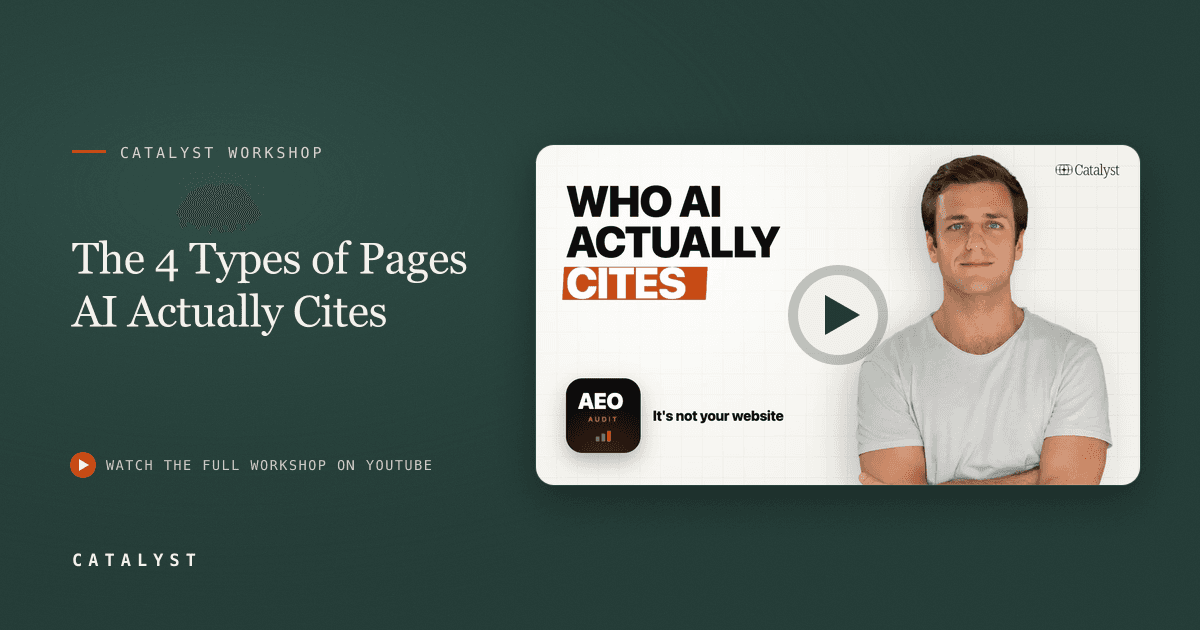
82% of AI brand mentions come from pages you do not own. This workshop breaks down exactly which 4 types of third-party pages AI cites in B2B categories, why each model cites different ones, and how to audit which sources are driving citations for your competitors right now.

Will Leatherman
Founder, Catalyst
TLDR
- Four page types drive most AI citations in B2B categories
- Best-of lists, review platforms like G2, Reddit threads, and reference sources like Wikipedia
- 86% of top citation sources are not shared across ChatGPT, Perplexity, and Google
- One strategy tuned to a single engine leaves the other three uncovered
- Find which sources each model uses in your category, then earn a named mention there
Most teams improving their AI search presence start with their own website. They add FAQ sections, restructure pages, and optimize metadata. That work matters, but it addresses the smaller half of the problem.
Geonimo's analysis of 50,000+ AI responses puts 82% of brand mentions in AI answers on outside sources. Those are pages on other websites that the model trusts and cites. Your homepage plays a minor role in whether AI recommends you. The sources that matter most are the ones you do not control directly.
The workshop covers how those citations work and which 4 page types produce most of them. It also walks the audit that reveals which sources drive citations in your market.
Catalyst has worked with companies ranging from pre-revenue startups to Series D businesses on AI search strategy. The citation patterns are consistent across industries. The gap between brands that show up and brands that do not is almost entirely earned coverage on the right outside pages.
What Are the 4 Types of Pages AI Cites Most Often?
Not all third-party pages carry equal weight. Analysis of AI citation patterns across the major models points to 4 types that account for the majority of B2B citations.
| Page Type | Why AI Cites It | Examples | Share of Citations |
|---|---|---|---|
| Best-of lists and comparisons | Pre-curated comparisons match how buyers search, and engines lift the rankings verbatim | "Best CRM tools 2026," "Top AI writing tools for B2B" | ~43.8% of ChatGPT citations (Ahrefs) |
| Review platforms | Structured data, verified buyers, and category taxonomy that LLMs can parse cleanly | G2, Capterra, TrustRadius | High, matched to purchase-intent queries |
| Community threads | Real buyer language, stated pain points, named alternatives, and Perplexity weights Reddit heavily | Reddit, niche forums, LinkedIn comments | ~40% of citations across engines (Profound, 30M citations) |
| Broad reference sources | High authority, structured data, and encyclopedic coverage that ChatGPT's training leaned on | Wikipedia, Wikidata, Crunchbase | Brands with a Wikipedia entry get cited 4.1x more often (WinWithSEO, 3,200-query study) |
The mechanic is borrowed credibility. A source AI already trusts names you, and that trust carries over to you. Getting mentioned on a G2 profile or a Wirecutter-style comparison carries more citation weight than adding another page to your own site.
Why Does Each AI Model Cite Different Sources?
The 4 page types hold across models. The specific sources inside each type change from model to model. Ahrefs studied 76.7M AI Overview responses, 957K ChatGPT citations, and 953K Perplexity citations. 86% of top citation sources are not shared across ChatGPT, Perplexity, and Google. Only 7 of the top 50 citation sites appear in all 3 engines.
The divergence follows each model's training emphasis.
- ChatGPT was trained heavily on Wikipedia and structured web content. Formal, wiki style information architecture and authoritative editorial sources perform best.
- Perplexity weights community platforms heavily. Reddit is one of its most cited domains and accounts for roughly 47% of Perplexity citations according to Profound's panel of 30 million citations.
- Google AI Overview extends Google's E-E-A-T standards and prefers pages already ranking in organic search. Domain authority matters more here than on other models.
- Gemini and Claude blend editorial and community sources. Both update their citation behavior faster than ChatGPT as new content enters their retrieval index.
A live audit of a CRM company in the workshop found it showing up consistently on Gemini and nearly invisible on ChatGPT and Perplexity. Each gap pointed to a different page type. A Wikipedia stub for ChatGPT, a Reddit presence for Perplexity, and comparison articles on category blogs for both.
A single content strategy built around one model's preferences fails the other 3. The audit reveals which models you are missing and which page types to pursue first. See How to Audit Your AI Search Ranking in 20 Minutes for a full walkthrough of the audit process.
What Makes On-Site Content Quotable Enough for AI to Cite?
Third-party pages drive most citations. Your own site content determines whether AI can lift a specific claim, statistic, or recommendation and attribute it to you. LLMs already hold foundation knowledge. Ask a broad educational question and they answer without naming any company. Getting cited means giving them information they do not already have.
2 types of on-site content do that.
Proprietary data. Numbers, findings, or structured datasets that only your company can produce. Ramp.com builds published indexes from its own customer spend data. That content is uncopyable and citable because no other source has the same numbers. Research reports built on internal data follow the same principle.
Original expert perspective. A specific, defensible stance on a topic from a credible named author. Generic category overviews stay uncited because the model already contains a version of the same information. A specific argument supported by a real case example is citable because it is new.
The research backs this up. The Princeton/Georgia Tech GEO study (Aggarwal et al., KDD 2024) tested what moves AI citation frequency. Adding cited sources, statistics, and direct quotations produces up to a 40% visibility lift. That is the biggest thing you can control in the whole study. Writing more content at the same level of generality produces no lift.
How Do You Find Which Sources AI Uses in Your Category Right Now?
Knowing the categories is the starting point. Your target list comes from the specific sources AI uses to answer questions in your market today. Those differ by category, by query type, and by model.
The process has 5 steps.
- Run fresh LLM queries using buyer language across ChatGPT, Perplexity, Claude, Gemini, and Google AI Overview. Use bottom-of-funnel queries. "Best CRM with AI deal automation for mid-market teams" surfaces different sources than "best CRM."
- Extract every URL cited across all 5 responses. Each URL is a source the model trusts enough to cite for that query.
- Classify each URL by type (listicle, review platform, Reddit thread, editorial blog) and by model.
- Build a ranked target list. The sources appearing most often across models are your priority placements. The ones appearing only on Perplexity point to Reddit and community gaps. The ones appearing only on ChatGPT point to editorial and Wikipedia gaps.
- Check your competitors against the same list. If a competitor appears on 8 of your 10 target sources and you appear on 2, the citation gap is structural.
The CRM company audited in the workshop ended up with a short target list. Specific blog articles from monday.com, LinkedIn posts from Cybill, and a set of G2 comparison pages. Getting named in future editions of those pieces moved citations faster than anything they could do on their own site.
The Catalyst AEO audit tool runs this process automatically across 5 models. It returns a ranked map of the sources driving competitor citations in your category.
What Signals Tell AI Your Company Is a Credible Entity?
Citations originate on third-party pages. Whether AI names your brand also depends on how many credible external sources have independently established you. That means confirming you exist and carry a reputation. Call it entity authority.
The key signals that build entity authority for B2B companies.
- G2 or Capterra profile with verified reviews and complete category tagging
- Crunchbase listing with accurate funding stage, description, and founding team
- LinkedIn company page with consistent activity and a clear description of what the company does for whom
- Wikipedia entry with a Wikidata link (4.1x citation lift, per WinWithSEO's 3,200-query study)
- Press mentions from industry publications that reference the company in the context of its category
These signals verify that you exist. Earning placement on the pages above is what gets you cited. When an LLM decides whether to include your brand in a category answer, it checks these sources to confirm you are a real, credible company. Strong entity signals plus good outside coverage ranks consistently. Strong entity signals with thin coverage still gets skipped on category queries.
For more on how entity signals interact with AI citation frequency, see How B2B Marketing Teams Get Named in AI Search.
What Does a 30-Day Plan to Close a Citation Gap Look Like?
The CRM company audited in the workshop showed up well on Gemini and was nearly absent on ChatGPT and Perplexity. The 30-day plan that came out of that audit had 3 priorities.
Week 1 to 2. Target the highest-traffic comparison articles. Identify 3 to 5 ranked listicles in your category that already generate ChatGPT and Perplexity citations. Contact the authors directly and ask to be included in their next update. Many are maintained by independent bloggers or small content teams who respond well to direct approaches. People say yes more often than you would expect.
Week 2 to 3. Fill the Reddit and G2 gaps. If Perplexity is your weakest model, answer real buyer questions in relevant Reddit threads as yourself. Then make your G2 profile complete, current, and tagged for the categories you want to appear on.
Week 3 to 4. Build or claim one high-authority reference source. If you do not have a Wikipedia entry, create one. If you have one but it lacks a Wikidata sameAs link, add it. If you have original data sitting in internal dashboards, publish a structured summary as a market report. These take longer to index but produce persistent citation lift across all models.
Run the audit again after 4 weeks. AEO gives faster feedback than SEO. Major improvements show up within a couple of weeks, and running the audit weekly tracks what is working. Cite your own improvement numbers once they are real. That kind of proprietary performance data is itself citable.
The Takeaway
AI builds its answers from pages it already trusts. 82% of the time, those pages belong to someone else. The 4 page types doing most of the work are best-of lists, review platforms, community threads, and broad reference sources. Each major model weights them differently. Consistent visibility across models needs a map of which sources each model uses in your category today.
Run fresh queries across 5 models this week using your buyers' actual language. Extract every cited URL. Identify whether your gap sits in editorial listicles, review platforms, or community sources. That 30-minute exercise tells you where to spend the next month. Use the Catalyst AEO audit tool to run it automatically and get the source map with competitor coverage already included.
The Content Engineer
Enjoyed this article?
Frameworks like this, weekly. No fluff, just original research and actionable insight.
More in AEO

3 ways B2B startups can build entity authority to get more clients from LLMs (and how Catalyst helps)
B2B startups winning clients from LLMs build entity authority deliberately. Here are 3 ways to do it, and how Catalyst engineers it at scale.
3 Plays That Turn AI Search Into a Revenue Channel for B2B Teams
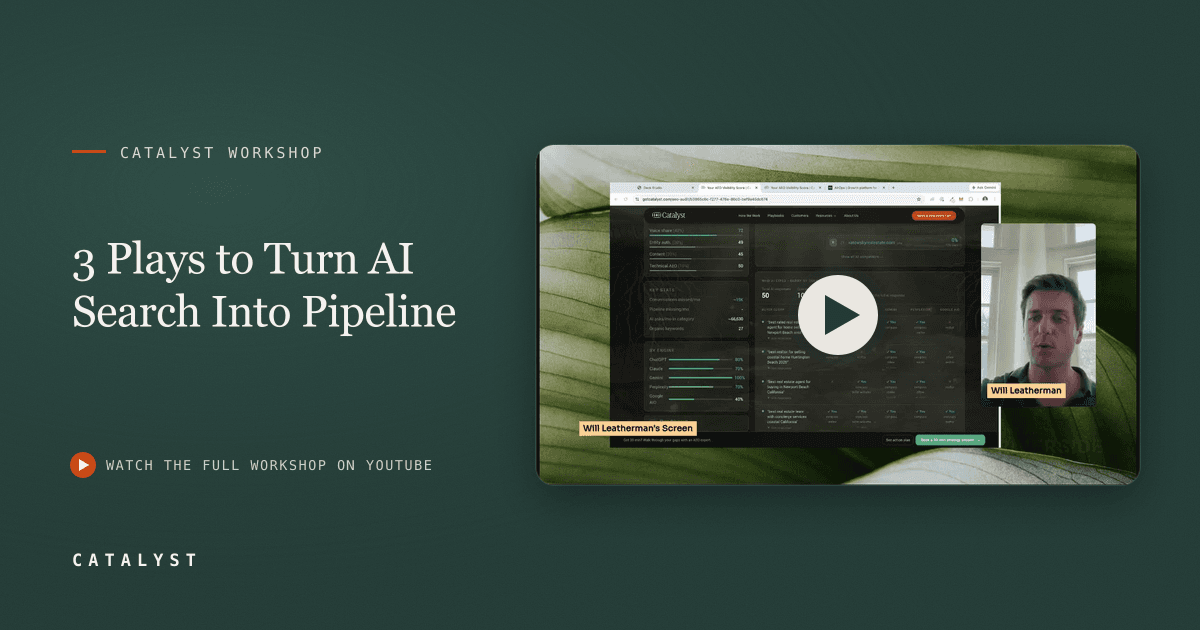
Most B2B teams treat AI search as a brand awareness play. This workshop shows the 3-play system that turns it into a measurable pipeline channel, with a live audit demo and a real client generating $8 million from AI citations in 12 months.
How to Audit Your AI Search Ranking in 20 Minutes
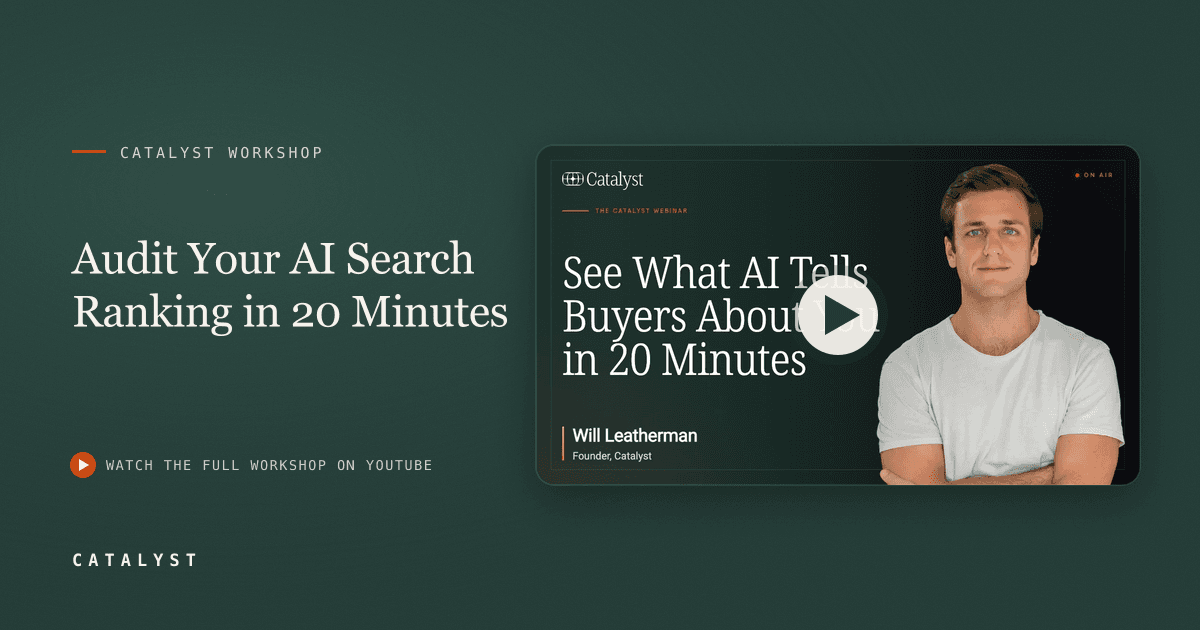
Most companies test their AI search visibility by asking their own ChatGPT or Claude account whether they appear, then assume the answer is accurate. This workshop shows what an unbiased audit actually reveals and the 3 specific gaps that determine whether AI recommends you or a competitor.
Ready to turn insight into pipeline?
We work with B2B companies that know content is the moat. Let's talk.