The 2 Hour AI Search Check That Shows Whether ChatGPT Names Your Company
Run 3 real buyer questions 10 times each, count what comes back, and you will know exactly which pages are writing the answer your buyers see before they ever reach your site.

Will Leatherman
Founder, Catalyst
TLDR
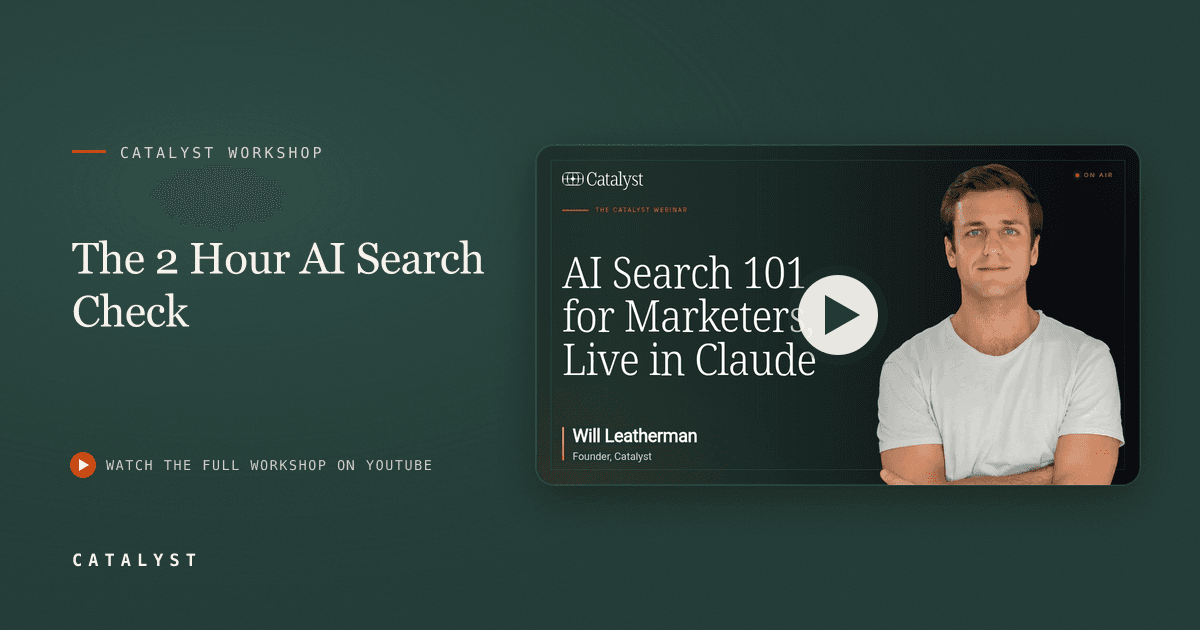
Answer engine optimization is the work of getting your company named when a buyer asks an AI tool instead of Google. For a B2B company of 50 to 500 people, the pages the model reads that day decide the answer, because it has no strong memory of you to fall back on. The check takes about 2 hours in week 1. Pick 3 buyer questions, ask each one 10 times in a fresh chat, count how often you are named out of 10, then sort each question into 1 of 3 piles that tells you whether the fix belongs on your own site or on somebody else's page.
A VP of marketing types "best platforms for a 200 person company" into ChatGPT on Monday morning and 3 names come back. If yours is not one of them, that shortlist got written before your sales team knew the buyer existed.
This is already showing up in the numbers. A field experiment found that when Google put an AI answer at the top of the page, clicks to websites fell by almost 40%. Bain puts roughly 44% of B2B buyers starting their search in an AI tool. Almost half your buyers are no longer starting on Google.
The advice around this is a mess. A review of the 6 most watched beginner videos on the topic, about 660,000 views between them, found they disagree on the basics. One of them tells you to add llms.txt and schema, then later in the same video calls obsessing over that a mistake. What follows is the version built on the research, taken from a 50 minute live workshop, so you can tell what to ignore.
Does ranking on Google mean ChatGPT will name you?
No. A team at the University of Toronto compared the sites ChatGPT pointed to against Google's top 10 for the same questions. The overlap was 4% on average, and for more than half the questions it was zero. A separate study found more than a third of the sites AI tools point to never show up in Google or Bing at all.
Treat AI search as its own channel. Keep doing SEO, because Google still sends you buyers. If you want to know what ChatGPT says about you, you have to go and ask ChatGPT. Perplexity overlaps with Google more, around 15%, so it tracks your SEO results more closely. ChatGPT drifts furthest from Google, which makes it the one to check first.
What it reads is not one search either. The model splits a buyer's question into a pile of smaller searches and runs them at once, a behavior called query fan out. Ahrefs reported a single deep research prompt about buying a red phone case that ran 420 searches. Then it reads far less than it finds. In a study of real ChatGPT use, it got about 28 results back per answer and used about 4 of them.
"On Google, you were fighting for the top spot on a list of 10 links and the buyer did the reading. Here, the AI is doing the reading and the buyer only ever sees what it kept." — Will Leatherman, Founder of Catalyst
Those 4 pages are the entire game. Getting cited just means being one of them.
Why does AI name big brands without reading anything?
Because it already remembers them. The same Toronto team found that 16% of the brands ChatGPT ranked were not in any of the pages it had just read. Those names came straight out of the model's training. When the researchers shuffled the pages the model was given, smaller brands moved about twice as far as famous ones.
"Giants get remembered. Everyone else gets looked up." — Will Leatherman, Founder of Catalyst
That is good news if you are a 200 person B2B company. You cannot make ChatGPT remember you overnight. You can get onto the pages it is still reading this month.
"Big brands get named from memory already and there's not much they can change. And so a company your size gets named from the pages, and pages are something that can change this month and next." — Will Leatherman, Founder of Catalyst
How many times should you ask before you trust the answer?
10 times, in a fresh chat every time. The common mistake is asking once, screenshotting the answer, and dropping it into a deck. SparkToro asked AI the same questions thousands of times and the identical list of brands came back less than 1 time in 100. On one B2B question, even the top brands showed up in only 30% to 40% of answers. One answer is a roll of the dice.
Research on how many runs it takes before the count settles found 5 was shaky and 10 was where it started to hold. Use a fresh chat each time, because the same chat remembers what it already told you and stops showing you what a buyer sees.
Then hand the saved answers to Claude and have it count them rather than estimate them. Asking a model how visible you are returns a confident guess. A guess is not a measurement. Read the result out of 10, because being named in 7 of 10 is a very different position from 2 of 10, and a single screenshot calls both of them "named".
Look just as hard at who got named instead of you. A rival appearing in 8 of 10 runs on a buying question is a pattern. A rival appearing once is noise. If one rival wins every question about a single topic, AI has decided that topic belongs to them, and that tells you which subject your pages have to own.
Every question then lands in 1 of 3 piles.
| What the run showed | What it means | Where the fix goes |
|---|---|---|
| Named, and a cited page names you too | That page is doing its job | Refresh it, 30 minutes a month |
| Named, but no cited page mentions you | It knows you from memory | Protect it, nothing urgent |
| Not named at all | Other people's pages wrote the answer | Your own page for buying questions, their pages for research questions |
If every question lands in pile 3, that is normal for a company your size and it is the most useful result you can get, because you now know exactly which pages are writing the answer. Most companies start here. The full method is written up in how to audit your AI search ranking in 20 minutes, and the free AEO audit runs the same 3 piles across more questions and every major model if 30 chats by hand is too much.
Which questions get fixed on your site and which get fixed somewhere else?
Tag every question as research or buying. That single tag tells you where the work goes.
| Question type | Example | Who wrote what AI reads |
|---|---|---|
| Research | "What should I look for in a payroll platform?" | Up to 86% other people's reviews, press and articles |
| Buying | "Which one fits a team our size and what does it cost?" | Half to two thirds the company's own website |
Build the list from the sentences buyers actually say. Pull them from your call recordings, because buyers ask out loud in the first 10 minutes. Pull them from your support and sales inbox, where people write in full. Then add the words buyers attach at the end, so best, top, versus, review, alternatives, and how much does it cost. That gives you 10 to 20 questions. Pick the 3 that matter most to revenue, make sure 1 of them is about price, and keep the rest as your topic map.
Write those 3 down word for word and do not touch them. You are asking the same 3 next month, and a tweaked question cannot be compared across runs.
What makes a page that AI can actually quote?
Facts. One study of what makes a page shape the answer found it came down to definitions, numbers, comparisons and steps. Formatting a page as question and answer, on its own, did almost nothing.
Usually the page already exists. Your pricing page or your comparison page is sitting there, never saying the answer plainly. Here is the difference.
- "Flexible plans for teams of every size. Contact us for a quote." Nothing in that sentence can be repeated to a buyer.
- "Plans start at $400 a month for up to 50 people, and most teams of 200 pay about $1,200." Every part of that can.
The second sentence is one an AI can lift straight into an answer, and it answers the exact buying question a 200 person team asked.
Pricing is the page to check first. One study of more than 13,000 answers across about 108 software brands found AI got the full price list right about 1 time in 4, and 2 out of 3 of the wrong prices were too low. Brands that publish no price at all still got one quoted 8 times out of 10.
"If you're not the one saying your price, AI is going to make it up or pull it from whatever source it can." — Will Leatherman, Founder of Catalyst
Picture that from your rep's side. The buyer arrives at the first call with a number that is too low and the conversation opens by walking it backwards. If your deals are genuinely custom, publish a range or a starting price.
Four habits make the rest of the page work.
- Put the answer first in every section, because the model weighs the start of a passage more heavily than the middle.
- Make each section stand alone, because your page gets read in chunks and you do not control where they fall.
- Name things specifically, so the product name and who it is for, never "this tool helps teams".
- Keep it fresh. Ahrefs found 3 quarters of the pages ChatGPT used had been updated in the last 30 days.
Refreshing is not rewriting. Update the numbers in the one section that answers a question a buyer asked you this month and change the date. 30 minutes a month across your 3 most important pages is enough to start.
What should you skip?
A lot of the popular advice measured near zero.
- llms.txt. Two studies covering hundreds of thousands of sites found having the file made no difference.
- Word count. An analysis of about 174,000 pages found almost no link between length and getting used, and more than half the pages AI used were under 1,000 words.
- Rewriting tricks. A benchmark tested the published methods for rewriting pages for AI. Most did not work and some made things worse.
"Tricks wear off. Clear facts on the right pages will hold." — Will Leatherman, Founder of Catalyst
How do you get named on pages you do not own?
Your own site only covers the buying questions. On the research questions buyers ask first, up to 86% of what AI reads is somebody else's page.
"Your own site is saying you're good. Other people's pages are everyone else saying it, and AI inherently trusts the second one significantly more." — Will Leatherman, Founder of Catalyst
Ahrefs studied 75,000 brands and found the factor most closely linked to showing up in AI answers was how often other websites mentioned the brand, ahead of links to your site and ahead of your SEO score. The model is also looking for agreement, so settle on 1 sentence that says what you do and who it is for, and use it on your homepage, your LinkedIn, your review site profiles and your partner pages.
"If five places describe you five different ways, AI has nothing it can agree on. If five places say the same sentence, that's the sentence it will repeat." — Will Leatherman, Founder of Catalyst
Three kinds of pages are worth the effort, and they are ranked here by difficulty.
- Lists, reviews and comparisons. Almost half the pages ChatGPT used were these. Hardest to earn, most valuable to hold. The 4 types of pages that drive AI citations breaks down which ones to chase.
- Communities your buyers actually use. Answer the real question as yourself, including when the honest answer is a competitor.
- Your own public accounts. YouTube is the site Google's AI answer points to most, and in the same Ahrefs research YouTube mentions tracked ChatGPT visibility more closely than any other factor measured.
Getting onto the lists is legwork. Find who wrote the article and when it was last updated, since most get refreshed yearly. Send the author 4 lines naming the list and the section you fit, who you are best for, your real price, and a login before their next update. None of those lines asks for a favor. There is a longer version of this play in how to get named in AI answers when 85% of your mentions sit on pages you do not own.
Before any of it, check one file. Ahrefs looked at 140 million websites and found about 6% block ChatGPT from reading them, usually from an old template or a Cloudflare bot setting that defaults to on. Open yoursite.com/robots.txt and look for a disallow next to GPTBot or OAI-SearchBot, ClaudeBot, or Google-Extended. If one is there, that tool cannot read your site and none of the page work counts.
How do you prove any of it is working?
AI search gives you nothing like Search Console, so track 3 things instead.
- Rerun your check monthly with the same 3 questions word for word. Compare the tables and ask whether a question moved up a pile, whether your count out of 10 rose on the questions you worked, and whether the rival who kept appearing dropped. That is a monthly report that fits on 1 slide, and it is covered in more depth in 3 checks that tell you whether your AI visibility score really changed.
- Group AI referral traffic in your analytics, so visits from chatgpt.com, perplexity.ai, claude.ai and gemini.google.com in 1 line you can watch month over month. Some of it goes untracked, so assume the real number is higher.
- Ask every new lead how they heard about you. Make it a free text box on the demo form rather than a dropdown, because buyers type "ChatGPT told me" in their own words and no dropdown would have offered it. Ahrefs found AI search was half a percent of their visits and 12% of their signups, and they only knew because they asked.
Why do this week instead of next quarter?
Because the shortlist is already being written. TrustRadius found most tech buyers seriously consider 3 products or fewer, and 6sense found the winning vendor was on the buyer's very first list 95% of the time. AI traffic to websites grew almost 10 times in the past year, so that first list is more and more often an AI answer.
"If you're not on it, your sales team is confirming a list somebody else wrote." — Will Leatherman, Founder of Catalyst
The takeaway
Here is the whole week, costed.
| When | Move | Time |
|---|---|---|
| Today | Check robots.txt for a disallow on GPTBot, OAI-SearchBot, ClaudeBot or Google-Extended | 5 min |
| Today | Add a free text "How did you hear about us?" field to your demo form | 5 min |
| Day 1 to 2 | Run 3 fixed buyer questions 10 times each in fresh chats and save every answer | 40 min |
| Day 2 | Count the answers and sort each question into 1 of the 3 piles | 30 min |
| Day 3 to 5 | Fix 1 page with your real price, or send 3 notes to list authors, whichever your biggest gap says | 45 min |
That is about 2 hours, and at the end of it you will know more about where you stand in AI search than most of your competitors know about themselves. Start with the robots.txt check today, because it takes 5 minutes and it can quietly cancel everything else. Then run your 3 questions, or let the free AEO audit run them for you across every major model and hand you the same 3 piles.
The Content Engineer
Enjoyed this article?
Frameworks like this, weekly. No fluff, just original research and actionable insight.
More in AEO

Where to Get a Package That Includes AI Search Visibility and Share of Voice Optimization
Compare what a package covering AI visibility and share of voice should include, and see what Catalyst covers in each SEO + AEO tier.

AEO, GEO and LLM SEO, What Each Label Means for B2B Buyers
Compare AEO, GEO, LLM SEO and AI search optimization. Catalyst decodes the four labels and the questions that reveal what a provider actually does.

What an AEO Agency Costs in 2026, and Where Catalyst's Pricing Starts
See what an AEO agency costs in 2026, what each of Catalyst's four offer lines includes, and the SEO + AEO entry price of $8,000 a month.
See where AI ranks you
The free AEO audit runs your buyers' questions through ChatGPT, Claude, Perplexity and Google AI Overviews, and shows where you are named and who is named instead.