Why AI Search Names You But Never Recommends You
A perfect technical score predicts almost nothing about whether ChatGPT recommends you. Three live teardowns of real B2B companies show where the gap sits and how to tell whether you have a citation problem or a recommendation problem.

Will Leatherman
Founder, Catalyst
TLDR
Being named, being cited, and being recommended in AI search are three separate outcomes that need opposite fixes. CorPay scores 100 out of 100 on technical with 19 schema types, and is still recommended only 6% of the time. Bamboo HR is named in 86% of answers in its category and was the top recommendation 0 times across 60 searches, while Linear has zero structured data, 1 citation in 46 answers, and 38% of every top pick in its field. A finished technical checklist is not sufficient on its own, so work out which of the three outcomes you are missing before you change anything.
A buyer opens ChatGPT and types who should I use for HR software. They get back a short list of names. Whether you appear on that list, and whether you are the one name the answer tells them to pick, are two different results with two different causes.
Answer engine optimization is the work of getting your company named and recommended inside AI assistant answers, and it matters most to B2B teams whose buyers now open an assistant before they open Google. The technical half of that work has a reputation for being mysterious. It is not. It is also not where most companies are losing.
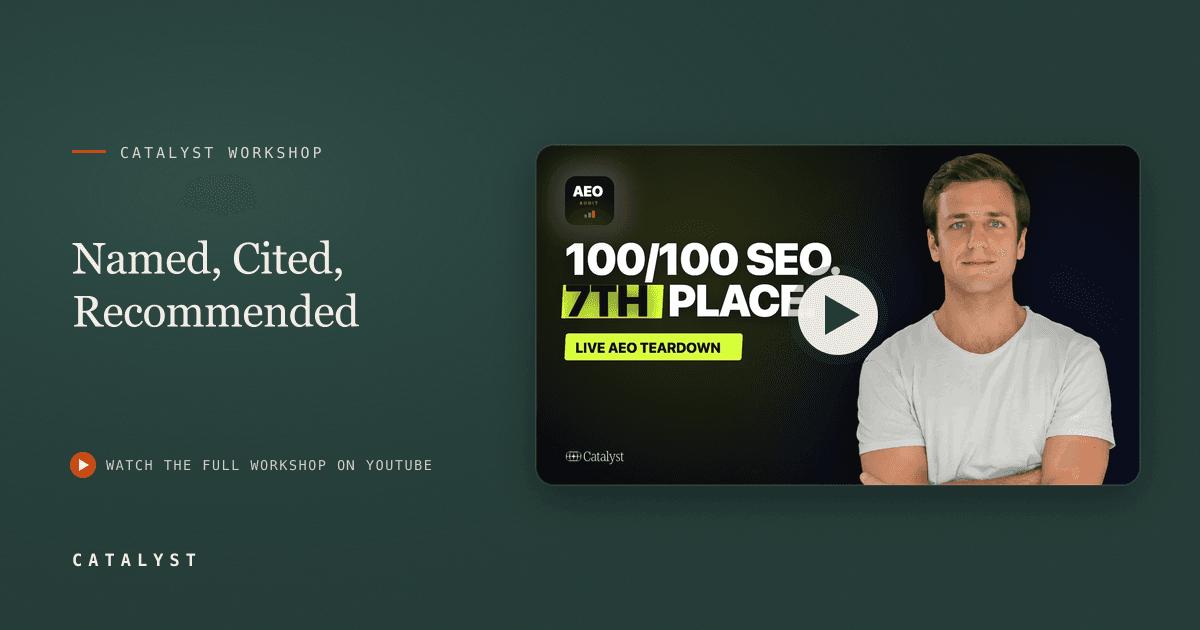
In a live workshop, Will Leatherman ran a full audit on three real companies in three categories, CorPay in AP automation, Bamboo HR in HR software, and Linear in product development tooling. All three have a live `llms.txt` file. All three win for completely different reasons, and broad technical advice predicts none of them.
What is the difference between being named, cited, and recommended?
Three metrics, three meanings. Voice share is how often an answer mentions you at all. Citation rate is how often an answer uses one of your pages as its source. Top recommendation share is how often the answer tells the buyer to buy you.
"When an answer cites your page, it's using you as a source or a fact. And when an answer recommends you, it's naming you as the thing to buy. Those are very different jobs, and an explainer only ever does the first thing."
That distinction is the whole workshop. An explainer post earns the citation and never earns the purchase, because nothing in a definition makes a case for the vendor who wrote it.
Getting named is also not zero sum. The percentages across a category do not add to 100, because a single answer names several companies at once. You are not taking share off a competitor so much as entering answers you are currently absent from.
Why does a 100 out of 100 technical score still leave you in 7th place?
Because markup labels your content and never argues for it. CorPay ships 19 schema types on one page, all implemented correctly, plus a live `llms.txt` at the root. The technical half of the audit scores it 100 out of 100. Its overall AEO score is 48.
The outcome is 26% voice share, roughly 7th on its category leaderboard, behind Tipalti at 71%, Coupa at 53%, AvidXchange at 38%, and Medius at 34%. It is cited in 10 of 49 answers, a 20% citation rate. It is recommended 6% of the time.
The markup is doing its job. ChatGPT genuinely reaches for CorPay when it needs to explain AP automation. The citations come from a well produced resource library full of pages like what is a virtual card and how does AP automation work. Then the answer needs to name 3 vendors to consider. Nothing in that explainer made a case for CorPay, so it names the incumbents instead.
Will labels the gap between those two numbers a ghost citation, when you are the source of the information and not the pick. CorPay's ghost citation rate is about 10%, down from a third in August.
Schema is a labeling system. FAQ markup says the thing below this is a question, which makes a page easier to parse. It does not make the contents worth repeating. Same with `llms.txt`, which all 3 companies here already publish, including the one with no structured data at all. If you came looking for a reason to go write one, that is not the finding.
The fix runs in 2 steps, in order.
- Give each buyer question its own page, with the question written as the heading, so there is something for the answer to match against.
- Publish a figure from your own transaction data that nobody else could publish, so there is something worth naming you for rather than quoting you for.
Why does 86% voice share produce 0 recommendations?
Because brand mass gets you mentioned and a liftable sentence gets you picked. Bamboo HR has the opposite problem to CorPay. It is named in 86% of answers in HR software, ahead of Rippling, Workday, and ADP. Across 60 competitive searches it was the top recommendation 0 times.
At the time of the scan its homepage H1 read from HR platform to HR partner with Bamboo AI. An assistant writing an answer about HR software finds a page that never says HR software, describes a transition, and names a product nobody asked about. The title tag does name the category, which is why the page ranks perfectly well in normal search.
"LLMs are quite lazy. They want to see and copy the exact text you have on your page and paste it back into the chat."
Search rewards a page for being about a topic. An answer rewards a page for containing a sentence worth repeating. Its markup is thinner than its reputation too, 4 types covering organization, contact point, postal address, and aggregate rating, with no FAQ schema at all, and a technical score around 50. It still ranks first in its category on voice share.
What carries the 86% is the 30,000 customers line and 20 years of other people writing about it. Of the citations found in the scan, only 2 point at Bamboo HR's own pages, against 465 from independent sites and 74 from rival pages. Competitor blog posts are teaching the LLMs that Bamboo HR exists while its own pages contribute almost nothing.
"Nobody can copy 30,000 customers. That's something you actually have to earn."
Which makes it the least useful finding in the session, and the reason the real opportunity sits in the content. This is a company holding payroll and headcount data for 30K businesses. It could publish anonymized hiring benchmarks across that base, something no other company on earth has access to. None of its posts use that data.
There is a mechanical problem underneath all of it. The scan checks whether a live crawler can actually fetch the page, and on Bamboo HR it cannot. Cloudflare bot protection is blocking agent fetches by default. Nothing to do with privacy, just bot protection doing its job too well.
"Even if they did publish the best proprietary data in the industry, the thing that would keep stopping them is that LLMs can't even read it."
Check this on your own site first. Teams are consistently confident they have handled it and consistently have not.
How does a site with 0 schema win 38% of the top picks?
By being the subject other pages write about. Linear has no structured data on its homepage. No organization, no FAQ, no article markup, not one line of JSON-LD, against CorPay's 19 types. Its overall AEO score is 65, ahead of CorPay's 48.
It is cited once in 46 answers, a 2.2% citation rate, the lowest of the 3. It is named the best option 32 times, 38% of every top recommendation awarded in its category, on 71% voice share.
| Company | Schema types | Technical score | Voice share | Top recommendation share |
|---|---|---|---|---|
| CorPay | 19 | 100 out of 100 | 26% | 6% |
| Bamboo HR | 4 | about 50 | 86% | 0 of 60 searches |
| Linear | 0 | 80 out of 100 | 71% | 38% |
Put the 2 extremes side by side. CorPay is cited 10 times and recommended 6% of the time. Linear is cited once and wins 38% of the top picks. Cited the least, bought the most.
"Citations are not the goal. Citations are purely a side effect."
Linear's H1 reads the product development system for teams and agents. Read it the way an assistant would. There is a category, product development, a buyer, teams, and a differentiator, agents. The whole line lifts into an answer with nothing else added. Its one real technical defect is a duplicated H1 in the DOM, which drops its technical score to 80 rather than 100.
Its changelog does the rest. Timestamped entries going back years, first hand accounts of how the company runs on its own product, published by the people who did the work. A dated claim can be checked, and a claim that can be checked is one an answer can afford to repeat. That archive earns almost no citations, and it makes Linear the subject rather than the source. Reviews, comparisons, forum threads, conference talks, and other companies' blog posts all pull from it, and the recommendations come from there.
Bamboo HR bought that position with 30K customers and a long head start. Linear built it by publishing things only it could publish, on the record, with a date. That route is open today. It is the same mechanism behind co-citation, and it is why a site that fails every SEO check can still win in ChatGPT.
What is the fastest test of your own homepage?
Strip it to the H1 and read that line to someone outside your company.
"If you got rid of everything except your H1 and read it to someone outside of your company, if they can't tell you exactly what you sell and who it's for, then neither can an LLM, and it's going to have even less context than they do."
Compare the product development system for teams and agents against from HR platform to HR partner. One tells a stranger what the thing is. The other does not clear the bar for a human reader, let alone a model with less context than that reader.
Where should a buyer question live on the page?
In a heading, near the top. Asked live whether the buyer question has to be in a heading or can sit anywhere in the body, Will's answer was that the data shows best performance when it is the header. You can load additional queries into a post through the FAQ. An FAQ buried at the bottom has a high likelihood of never being seen, because assistants read roughly the top 30% of a page at any given time.
Structured pages also edge out CMS blog posts by a small but real margin, because the information sits still. Comparison pages are the clearest example. Which format to use comes down to what you can actually maintain, and a blog is fine if a blog is what you have. The page format matters more than the system behind it, which is the logic behind the 4 types of pages that drive AI citations.
How do you tell which problem you have?
Run your own category's buying questions and record 3 things separately.
- Were you named in the answer at all
- Did the answer cite a page of yours as its source
- Were you the company it told the buyer to pick
"Almost everyone finds that they are in one of two positions. They are either named and not recommended like Bamboo, or they're quoted and not recommended like CorPay. And those need the opposite fixes."
You cannot choose a fix until you know which one you are. A free AI visibility scan covers the same technical, on-site, and off-site checks used in these 3 teardowns.
One caution on the numbers. All 3 companies were rescanned 2 days before the session, and every count moved. Bamboo HR's voice share went from 53% to 86% between runs, partly real movement and partly measurement, because the question sets are not identical run to run. Two runs cannot tell you which. Treat any single reading as a reading taken that day and remeasure on a weekly cadence.
Three companies in three categories is also a small sample. It does not prove markup never matters. It does show that finishing the technical work is not sufficient on its own, and that published content is not equal across the board.
The takeaway
A finished technical checklist earns you the right to be read and nothing beyond that. CorPay proves it with 19 schema types, a live `llms.txt`, a technical score of 100 out of 100, 7th place, and 6% of top picks. Brand mass earns the mention, which is what 86% voice share and 0 recommendations means at Bamboo HR. Being written about by other people earns the recommendation, which is how Linear takes 38% of the top picks on 1 citation.
Do one thing this week. Run the 5 buying questions your category actually gets through ChatGPT, and log whether you were named, cited, or picked. Then confirm a live crawler can fetch your pages at all, because every other fix depends on that one.
The Content Engineer
Enjoyed this article?
Frameworks like this, weekly. No fluff, just original research and actionable insight.
More in AEO

3 ways B2B startups can build entity authority to get more clients from LLMs (and how Catalyst helps)
B2B startups winning clients from LLMs build entity authority deliberately. Here are 3 ways to do it, and how Catalyst engineers it at scale.
3 Plays That Turn AI Search Into a Revenue Channel for B2B Teams
Most B2B teams treat AI search as a brand awareness play. This workshop shows the 3-play system that turns it into a measurable pipeline channel, with a live audit demo and a real client generating $8 million from AI citations in 12 months.

How to Audit Your AI Search Ranking in 20 Minutes
Most companies test their AI search visibility by asking their own ChatGPT or Claude account whether they appear, then assume the answer is accurate. This workshop shows what an unbiased audit actually reveals and the 3 specific gaps that determine whether AI recommends you or a competitor.
Ready to turn insight into pipeline?
We work with B2B companies that know content is the moat. Let's talk.