3 Plays That Turn AI Search Into a Revenue Channel for B2B Teams
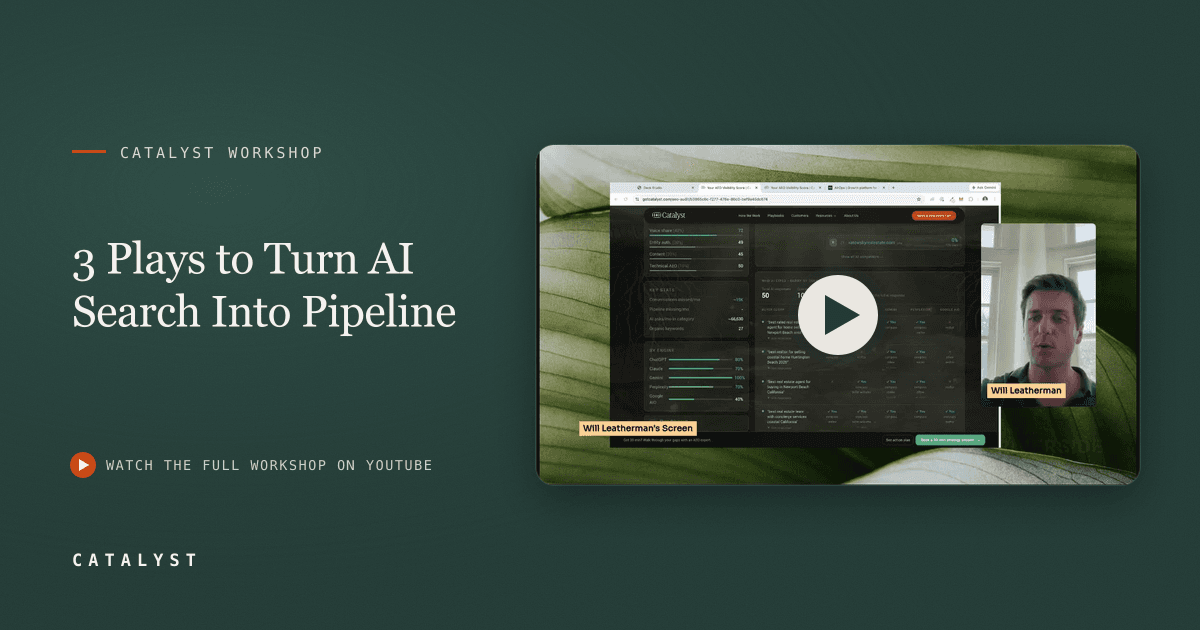
Most B2B teams treat AI search as a brand awareness play. This workshop shows the 3-play system that turns it into a measurable pipeline channel, with a live audit demo and a real client generating $8 million from AI citations in 12 months.

Will Leatherman
Founder, Catalyst
TLDR
Getting cited in ChatGPT, Perplexity, and Google AI is not enough on its own. To turn AI search into pipeline, B2B teams need 3 plays working together: map the exact full-sentence queries your buyers ask (not keywords), earn mentions on the third-party pages AI reads first (listicles, review platforms, community threads), and track share of voice over those queries the way you track any other channel. Rise, a global payroll company, used this system to generate $8 million in pipeline and 9,000 AI-driven sessions per month in 12 months.
There is a specific moment when a B2B buyer builds their vendor shortlist. In 2026, that moment often happens inside ChatGPT or Perplexity before they visit a single company website. The buyer types a specific question, gets 3 recommendations, and contacts those vendors. If your company is not in that list, you are not in the running.
Catalyst founder Will Leatherman walked through the full system in a live workshop, including a real-time audit of a volunteer company and a breakdown of how one payroll startup went from invisible to $8 million in attributable pipeline.
What is an AI search pipeline channel and who needs one?
An AI search pipeline channel is the practice of tracking and growing the percentage of buyer queries where your company appears in the AI answer, then measuring the revenue that follows. It applies to any B2B company whose buyers research vendors before buying, which is most of them.
Catalyst is a B2B go-to-market content agency that has worked with 150+ founders — from early-stage startups to multi-billion dollar companies — to build AI search as a measurable revenue channel. The plays in this article are drawn directly from that client work.
Why checking your own AI ranking gives you a false reading
Many founders open ChatGPT, search for their company, and see themselves appear. They conclude they are visible. That reading is wrong.
Every AI model maintains context. When you ask ChatGPT whether your company is well-known in its category, the model already has training data about you, your browsing history, and prior conversations. It inflates your apparent ranking. "You need to use a third-party tool that tells you, without any prior data, where you are actually ranking today," Leatherman said in the workshop.
The same distortion affects Google. Appearing at position 1 on a branded Google search tells you nothing about what a buyer sees when they type their question into ChatGPT with no context about your company. Both signals need to be checked independently.
Where AI gets its answers — and why your own website ranks last
This is the finding that surprises most B2B marketing teams: earned mentions on third-party pages drive roughly 10x more AI presence than your own website. Leatherman reported this consistently across Catalyst's client base.
AI models rank sources by how well they satisfy the answer for a specific query, not by your domain authority. The hierarchy for most B2B queries:
| Source type | AI citation weight |
|---|---|
| Best-of listicles ("Top 10 payroll tools for distributed teams") | Highest |
| Review platforms (G2, Capterra, Trustpilot) | Very high |
| Community threads (Reddit, Quora, niche forums) | High |
| Earned press (editorial coverage, not paid placements) | Moderate |
| Your own website, including the homepage | Lowest |
"The model trusts what other people are saying about you far more than what you say about yourself," Leatherman said. This shifts the strategy from publishing on your own site to getting mentioned on the sites AI reads first.
Each model also has distinct preferences. ChatGPT weights Wikipedia and YouTube heavily. Claude indexes Reddit and community discussions. Gemini prioritizes YouTube and Google's own AI Overviews. Targeting all three means different off-site channel mixes for each.
Understanding how entity authority compounds over time is the longer arc of this work. See 3 ways B2B startups build entity authority to get more clients from AI for the tactical breakdown.
Play 1: Map the queries your buyers actually ask
Stop tracking keywords. Start tracking full search queries.
On Google, a buyer searching for payroll software types 3-4 words. In ChatGPT, the same buyer types a full sentence with 4-5x more words — something like "best global payroll solution for a 200-person distributed company with employees in the EU and LATAM." That specific phrasing is what the AI is matching against. Keywords are a proxy; the full query is the actual target.
The prompt Leatherman uses to find these queries:
"I am a buyer evaluating [your category]. List the 10 questions I would ask before I pick a vendor. Then answer the top 3 and show which sources you used for each."
Run this in ChatGPT and Claude separately. Each will surface different queries and cite different sources. Write down every query both models return. These are your targets and your competitive map.
In the live workshop demo, this approach generated specific queries for a real estate company like "best real estate agent for selling home coastal home Huntington Beach 2025" and "best real estate team with concierge services coastal California" — far more specific than any keyword tool would surface. Each query was also region-specific, which revealed exactly which geographic markets the firm could win or was losing.
Play 2: Earn mentions where AI looks first
One mention on the right best-of list can move you into AI answers within a few weeks. The time to value is significantly faster than any SEO campaign.
The process is direct:
- Run the buyer query prompts from Play 1 and note which sources get cited in the answers
- Find the specific best-of listicles and review pages those answers reference
- Check whether your company appears on each page
- Pitch the author or publication a one-line update to be added — most accept it
Leatherman's team uses the free AEO audit at gotcatalyst.com to identify the top 10 off-site pages driving citations for any given query set. That list becomes the outreach target list. "If you want to do nothing else, it's kind of the bare minimum," he said. Just reach out and ask to be mentioned.
G2 profiles matter more in this context than most teams realize. Review platforms sit near the top of every model's citation hierarchy. Specific, detailed customer reviews on G2 give AI models a credible, structured source to cite.
LinkedIn is also becoming a top-cited source for AI answers in B2B categories specifically. Posting substantive, buyer-specific content weekly on LinkedIn now compounds into AI citations. This was not true 18 months ago.
Consistency of messaging across all channels matters for the same reason. If LinkedIn calls you a "marketing consultant," your website says "go-to-market agency," and a directory entry says "content strategist," AI cannot confidently categorize you. That inconsistency suppresses your citation rate across every query. Every external mention should describe your company the same way.
For a breakdown of how AI models build citations from co-mentions, see what co-citation means for AEO and why it matters.
Play 3: Measure share of voice and report pipeline over it
This is the play most B2B teams skip, and it is the reason AI search stays a novelty instead of a funded channel.
Share of voice in AI search means: out of the top 10-20 queries your buyers ask most often, how many return your company name in the answer? Track this number monthly. When it goes up after you earn a new off-site mention, you have attribution data. When demos increase alongside it, you have pipeline attribution.
Attribution from AI search does not always appear as "referred by ChatGPT" in Google Analytics. The dominant user behavior today is: search in ChatGPT, get a result, then navigate directly to the company's website or search the brand name on Google. This means AI is often the first touch and direct or branded Google is the last touch. You will see a lift in direct traffic and branded search before you see referral attribution.
The cleanest attribution method today is asking on every discovery call and intake form: "Where did you hear about us?" That one question, asked consistently, is how Catalyst clients track AI-driven pipeline.
Tools like AEROps automate the share-of-voice tracking across multiple queries and models. Leatherman recommends them specifically because their forward-deployed engineers help with setup and their query coverage is broader than most alternatives.
For current B2B AEO conversion benchmarks by category, see B2B conversion rates from AEO in 2026.
What this looks like when it runs: Rise's $8 million result
Rise is a global B2B payroll platform. When they started working with Catalyst, they were not ranking in the top 30 AI results for payroll category queries.
Over 12 months:
- Mapped buyer queries across 100+ target countries with different regional phrasing
- Ran the AEO audit to surface the specific listicles and review pages deciding each answer
- Earned mentions on those off-site pages
- Built a daily content system publishing original blog posts that answered specific buyer queries — with real payroll data, not generic definitions
- Tracked share of voice monthly and reported pipeline over it
Results: 9,000 AI-driven sessions per month, $8 million in pipeline attributed to AI search, and top-3 rankings for payroll provider queries across 100+ countries. "We've done this with a few of our clients where you know the large incumbent who had been dominating the first spot on Google for years — with just a few months of work, they've been able to rank higher on LLM search," Leatherman said.
The channel compounds the way SEO does: each new mention earns more citations, which drives more sessions, which generates more pipeline.
For more on the early-mover advantage in AI search — and why waiting for the channel to mature means losing ground that is hard to recover — see why AEO is becoming the top lead source for B2B startups in 2026.
What content actually gets cited
AI cites content when it contains something it does not already have in its training data. Generic category definitions never get cited — the model already knows those answers. What earns citations is specific, original material:
- Proprietary data (numbers only your company has access to)
- Market analysis built from real data your buyers cannot get elsewhere
- Expert perspective on a specific trend or decision — an opinion, not a definition
- Direct answers to the exact questions buyers ask, written with enough specificity that the AI cannot generate it from general knowledge
For B2B companies building this from scratch, 1 blog post per day is the right starting cadence. It builds coverage volume without triggering Google's quality filters. Each post should answer one specific buyer query, contain at least one number or observation the AI cannot generate on its own, and be written from a subject matter expert's perspective rather than produced from a generic AI prompt.
Original data and real research are the highest-leverage content type. Real estate transaction data, payroll compliance rates by country, industry survey results — any of these force AI to cite you as the source because no one else has it. See which content types earn the most AI traffic from Claude for a format-level breakdown.
The takeaway
AI search is already how B2B buyers build their shortlists. The 3-play system to turn that into pipeline is straightforward: map the full-sentence queries your buyers ask (Play 1), earn mentions on the third-party pages AI cites most often (Play 2), and track share of voice as a channel metric the same way you track any other revenue channel (Play 3).
None of this requires budget to start. Run the free AEO audit at gotcatalyst.com/audit to see where you currently rank, which off-site pages are deciding your answers, and what your top 3 actions are. Then add a share-of-voice row to your next marketing report and treat this as a channel.
The Content Engineer
Enjoyed this article?
Frameworks like this, weekly. No fluff, just original research and actionable insight.
More in AEO
How AlphaSense Wins 72.9% of AI Voice Share and the 4 Fixes You Can Copy This Week
AlphaSense holds most of the AI answers in market intelligence, and the thing carrying it is not budget. It is 41 pages that each answer one question a buyer actually types. Here is the teardown of 6 of their pages and the 4 fixes you can run on your own site, cheapest first.

3 Checks That Tell You Whether Your AI Visibility Score Really Changed
A B2B brand went from 53% to 86% share of voice in 6 weeks with nothing changed on its website. Run the 3 checks in this article against your own last reported number and you will know within an hour whether the move was real or whether your tracker simply asked different questions.
How Ramp Wins 40% of AI Search Share of Voice With a 29 out of 100 Visibility Score
Ramp gets named first when a finance lead asks an AI engine for the best spend management software, and it scores in the bottom third on an AI visibility audit. The gap between those two facts is the whole lesson, and 5 of the 6 fixes it points to cost you an afternoon.
Ready to turn insight into pipeline?
We work with B2B companies that know content is the moat. Let's talk.